SoC Evolution
Apple appears to follow a tick-tock cadence between the CPU + ANE subsystem1 and the GPU subsystem.
| Generation | CPU | ANE | GPU | CPU / GPU tick-tock |
|---|---|---|---|---|
| M1 / A14 | New platform | 16 cores / 11 TOPS | New Apple7 platform | New baseline |
| M2 / A15–A16 | Minor update | 15.8 TOPS | Minor Apple8 update | Overall refinement |
| M3 / A17 Pro | Medium update | Minor / medium update | Major Apple9 update | GPU tock |
| M4 / A18 | Major CPU update | Major increase to 38 TOPS | Apple9 refinement | CPU/ANE tock |
| M5 / A19 | Medium / major update | M5 Max: 25 FP16 TFLOPS / 50 INT8 TOPS (measured)2; A19: refinement | Major Apple10 update | GPU tock |
| M6 / A20 (predicted) | CPU complex redesign / expansion | Dual 16-core ANE | Apple10 refinement | CPU/ANE tock |
GPU Evolution
The A20 and M6 GPUs are predicted here to remain in the Apple10 family.
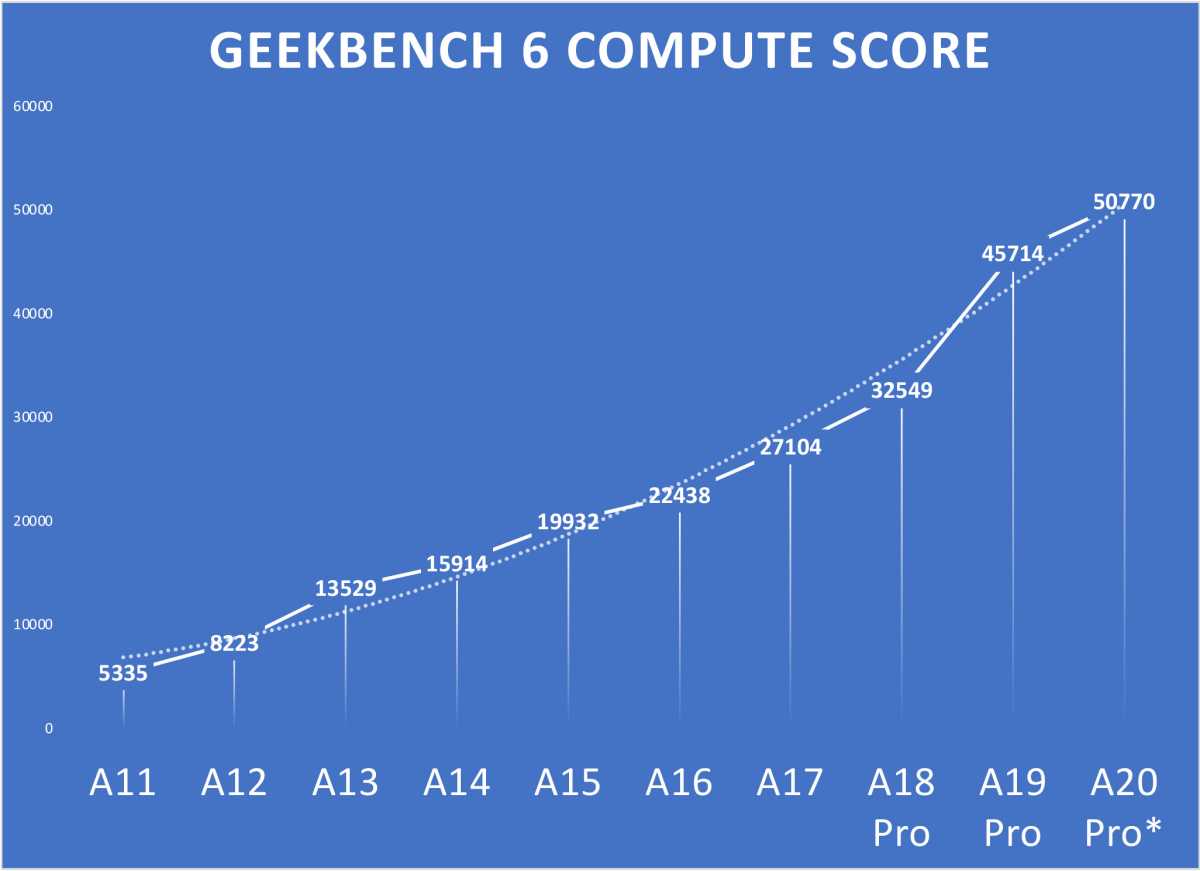
| GPU family | Representative SoCs | Peak SIMD-group FP16 TFLOPS (total / per core) | Peak NAX FP16 TFLOPS (total / per core) | Most important change |
|---|---|---|---|---|
| Apple7 | A14 / M1 | A14: 0.65 / 0.16 M1: 2.62 / 0.33 |
— | TBDR + SIMD32 + UMA; starting point of the M-series GPU |
| Apple8 | A15 / A16 / M2 | A15: 1.71 / 0.34 A16: ~1.79 / ~0.36 M2: 3.58 / 0.36 |
— | Cache, bandwidth, and efficiency improvements; no fundamental shader-core redesign |
| Apple9 | A17 / A18 / M3 / M4 | A17 Pro: 2.06 / 0.34 A18 Pro: 2.26 / 0.38 M3: 3.43 / 0.34 M4: 4.04 / 0.40 |
— | New shader core, Dynamic Caching, hardware ray tracing, and dynamic occupancy3 |
| Apple10 | A19 / A20 (predicted) / M5 / M6 (predicted) | A19 Pro: 4.98 / 0.82 M5: 8.30 / 0.82 A20 / M6: TBD |
A19 Pro: ~9.96 / ~1.64 M5: ~16.60 / ~1.64 A20 / M6: TBD |
A Neural Accelerator in every GPU core, 2× FP16 versus FP32 throughput, and Dynamic Caching Gen24 |
Each entry reads total / per GPU core for the highest-core base A- or M-series configuration. For Apple7–9, this table treats peak FP16 throughput as equal to FP32. For Apple10, SIMD-group FP16 is calculated as 2× FP32, while NAX FP16 is estimated as approximately 2× SIMD-group FP16. The NAX values are derived estimates, not measurements or Apple-published peaks. Except for Apple’s published 2.6-TFLOPS M1 figure, the base values come from reported GPU width and clock rate and are rounded to two decimals. Pro, Max, and Ultra variants are not included.5
Basic architecture
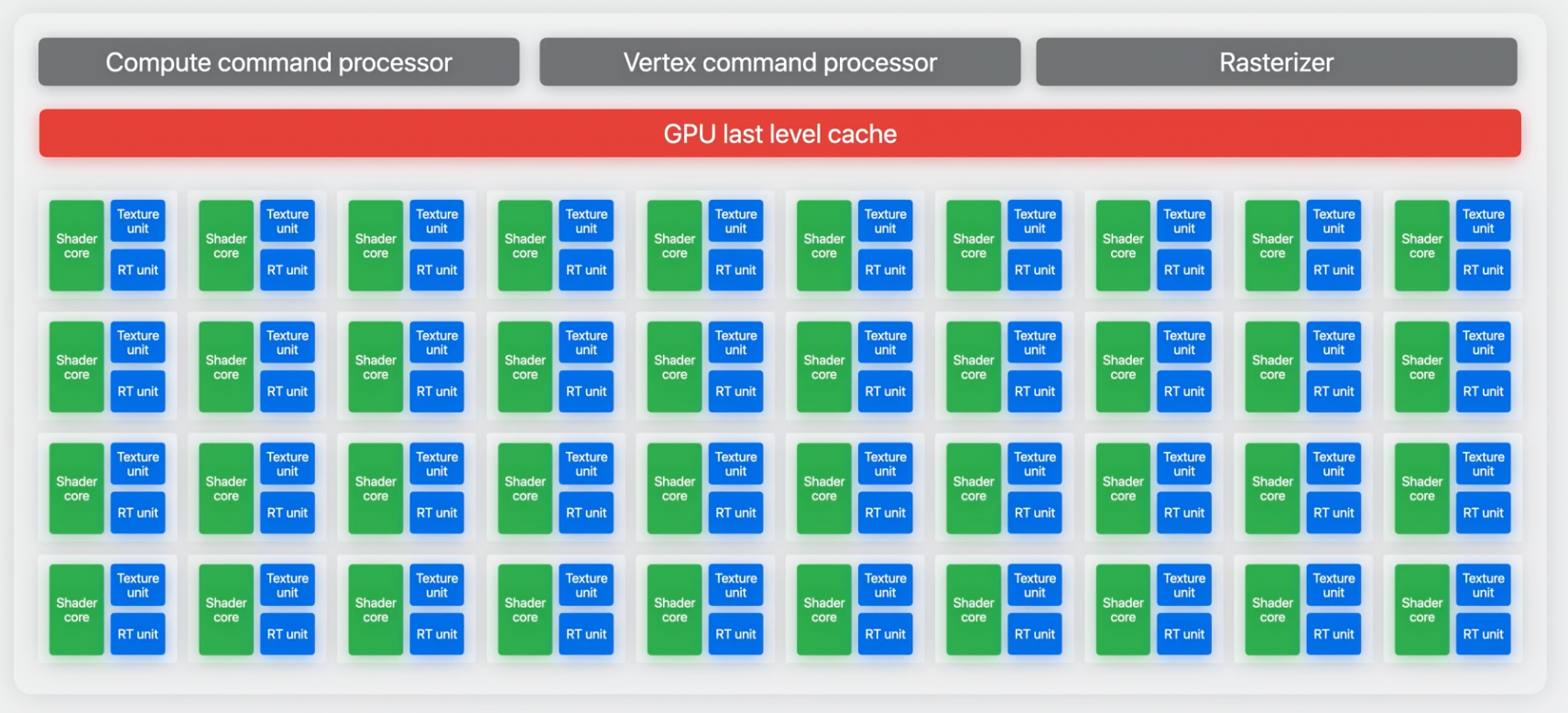
GPU subsystem:
GPU subsystem → L2 cache → GPU core → 4× Shader Core → 32 SIMD lanes → ALU pipes
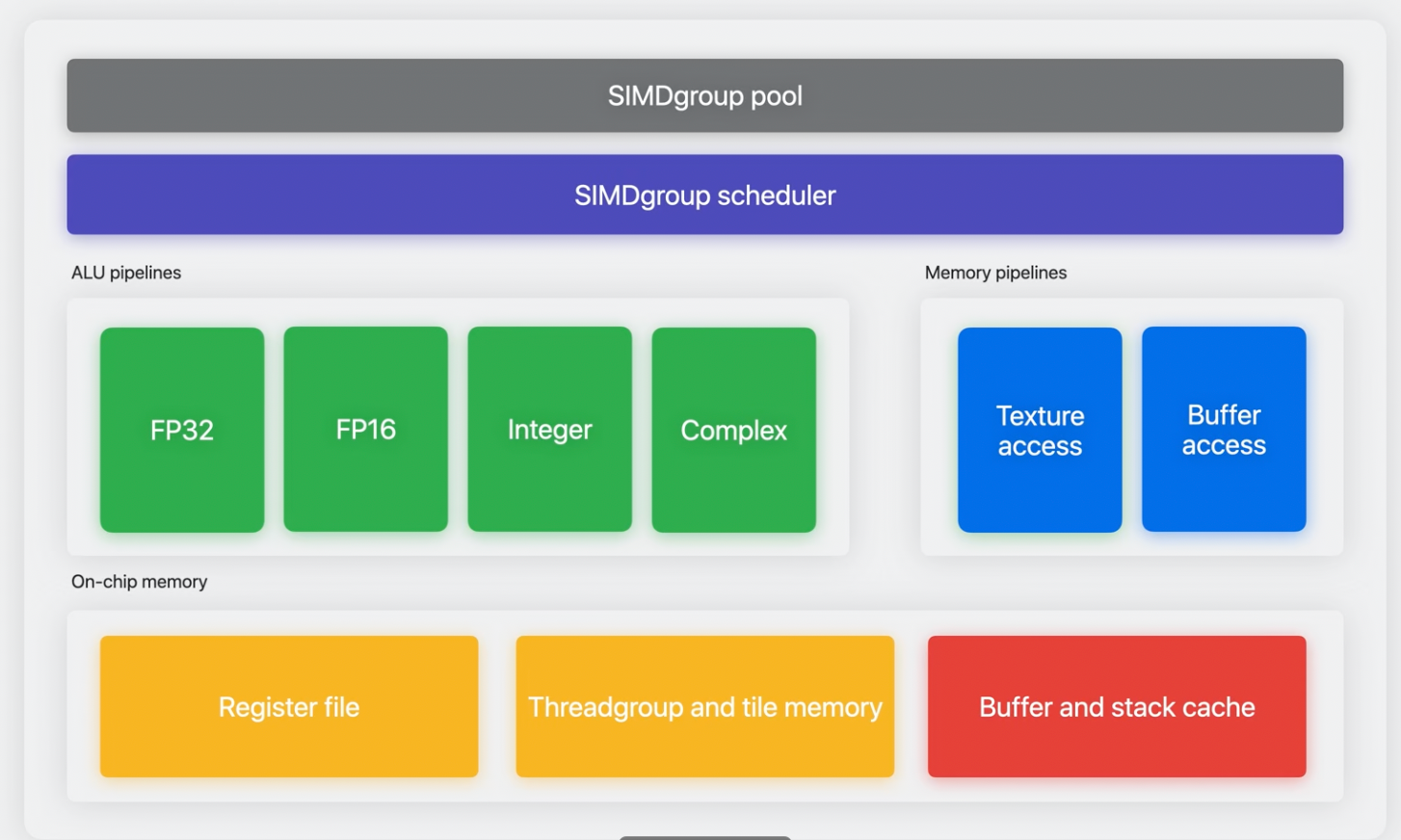
Shader Core (Streaming Multiprocessor / SM Core):
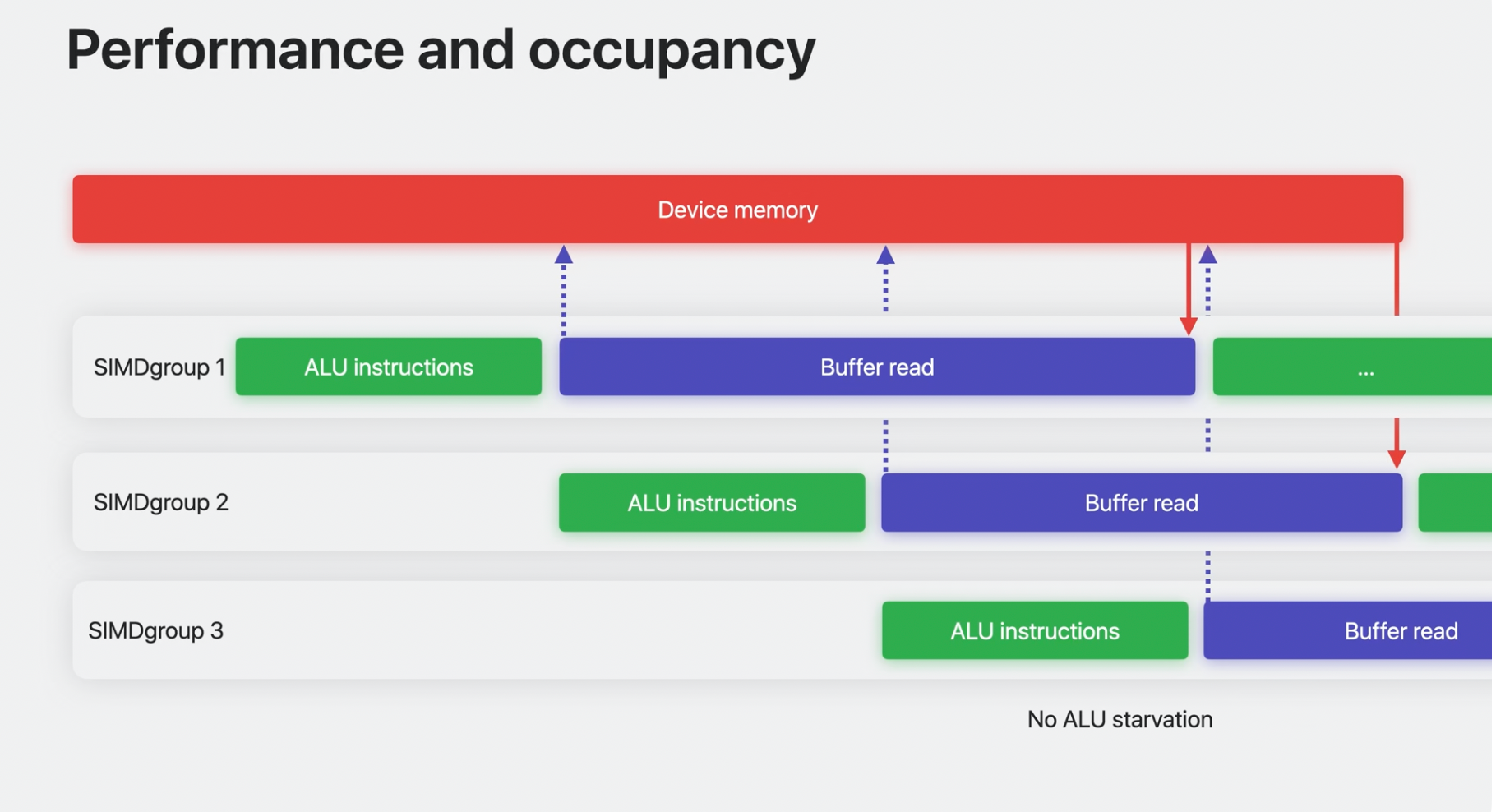
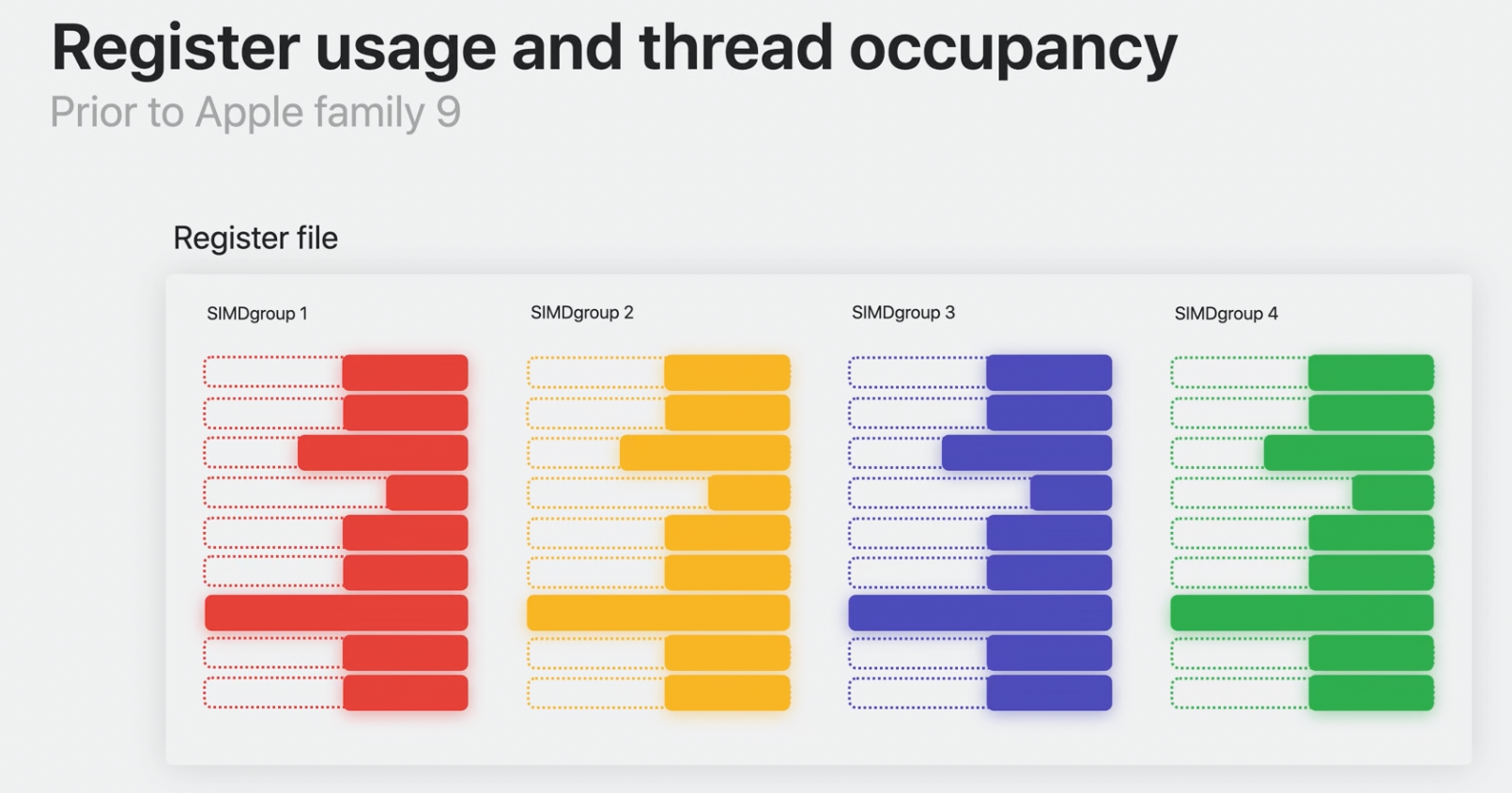
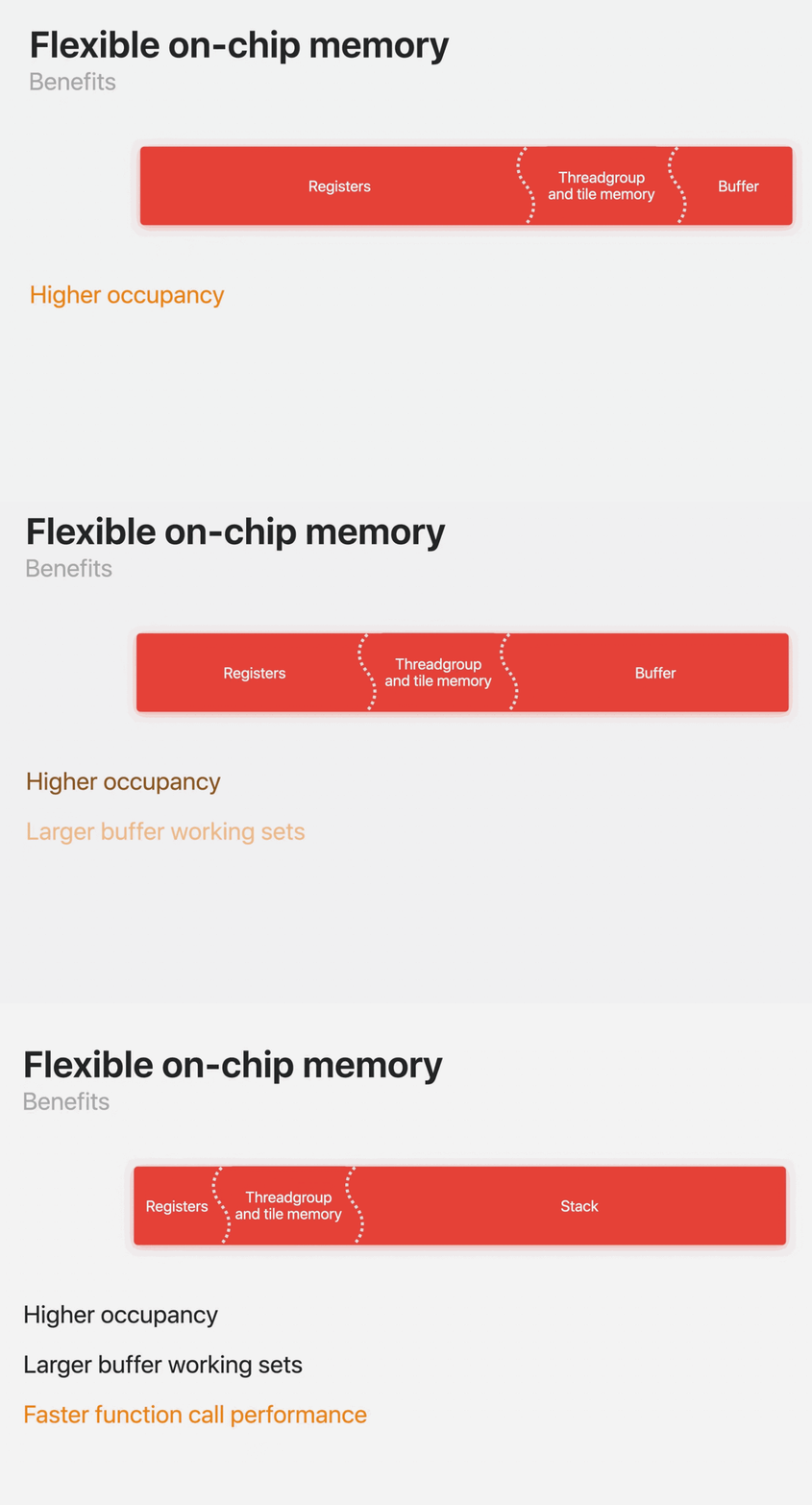
Preliminary — Occupancy
Higher occupancy leads to higher throughput: more of the available TFLOPS can be achieved when more SIMDgroups are ready to use the execution pipelines.3
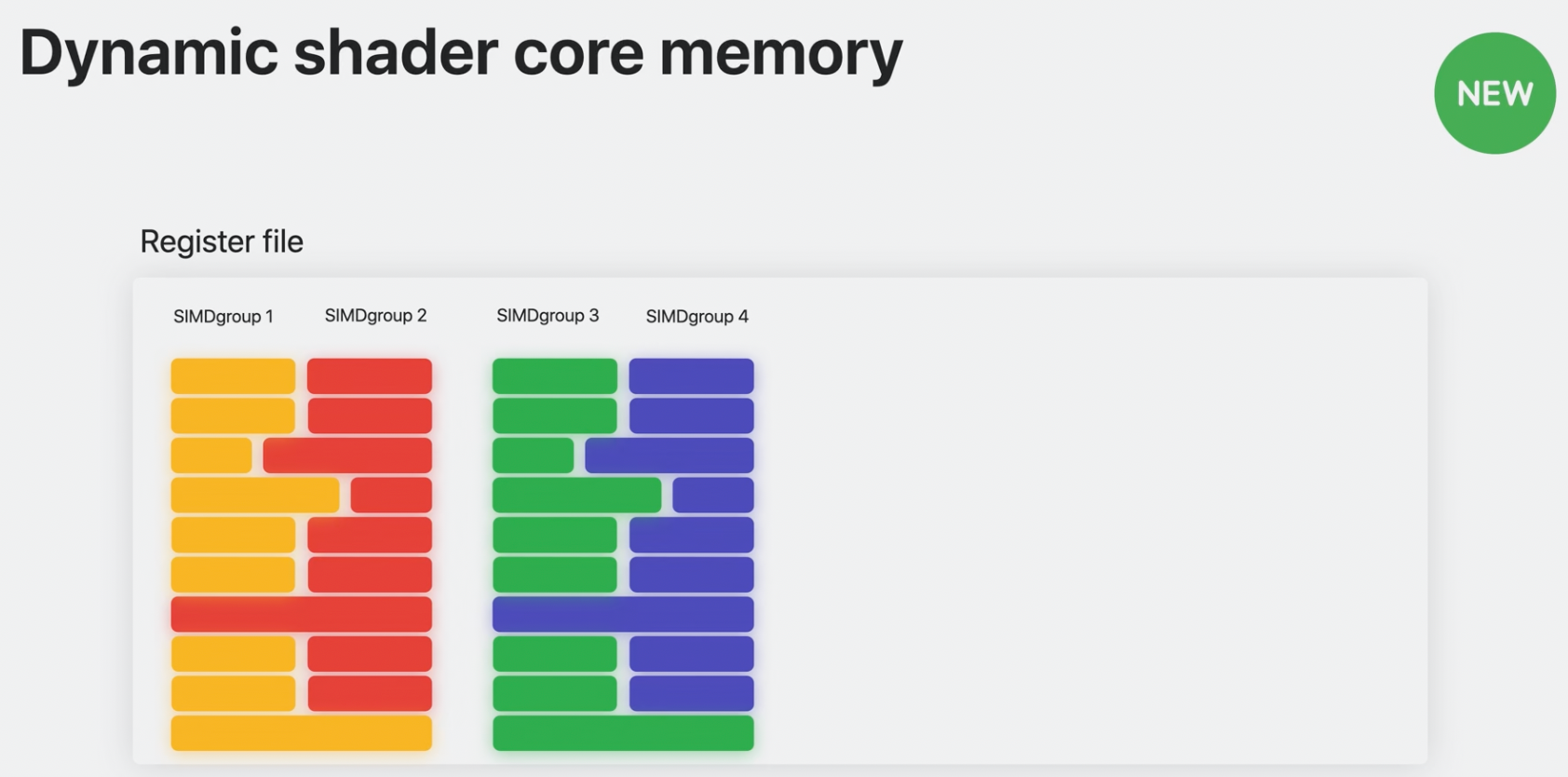
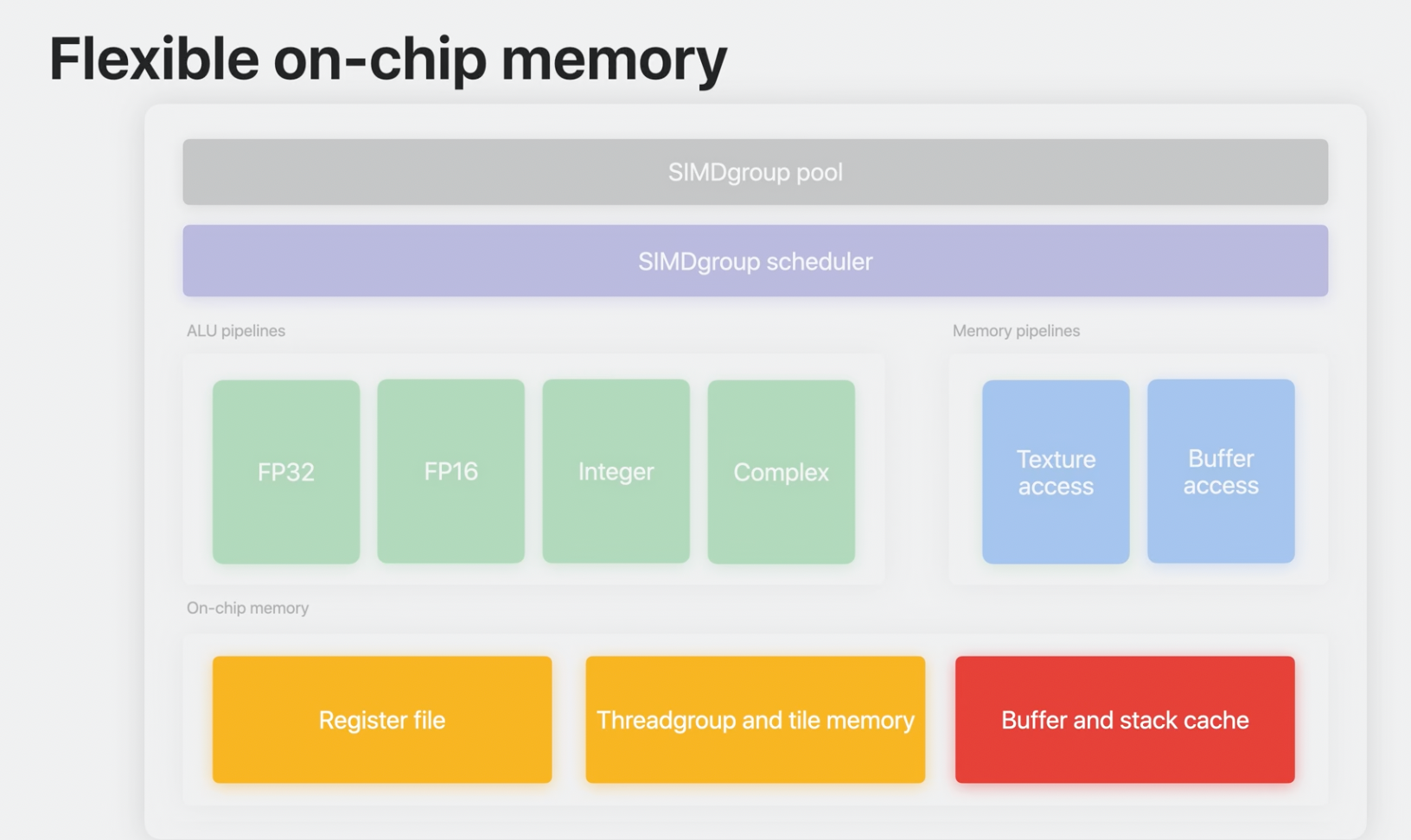
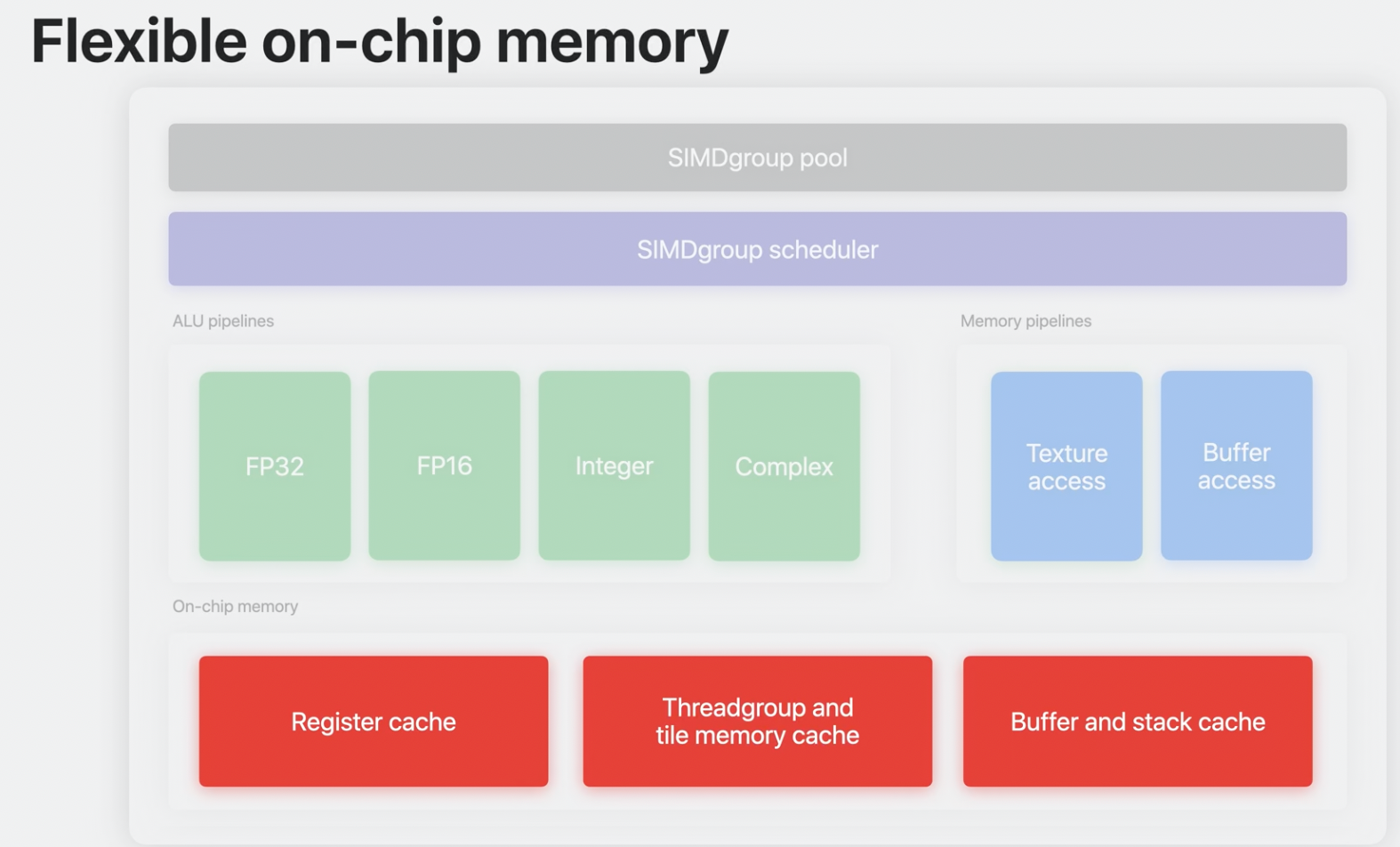
Dynamic Caching
- Dynamic register allocation
- Dynamic on-chip memory
- Occupancy Manage (Not covered in this post): decides when to schedule more SIMDgroups and when to schedule fewer to prevent register spilling3
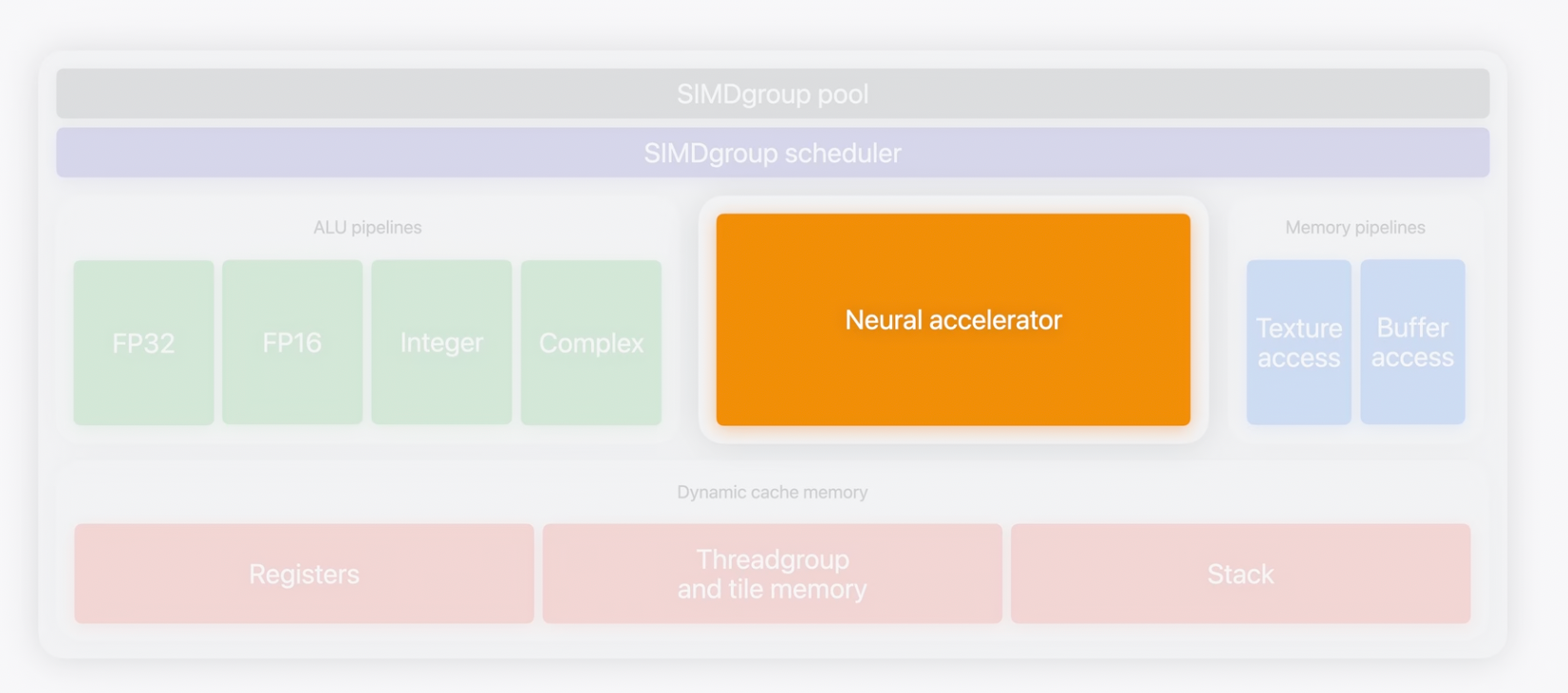
Neural Accelerator (NAX)
The Tensor Core era of the Apple GPU
M5 and A19 place dedicated matrix-multiplication hardware inside every shader core.4
Speedup from NAX
NAX changes prompt processing far more than token generation.
The cleanest complete comparison in the llama.cpp reports uses the same 40-core M5 Max and Llama 2 7B workload: pp512, tg128, and full GPU offload. The legacy result is the mean of two independent 8e672ef submissions, which agree within 1.4%; the NAX result is the accepted c1d0e7a Tensor API submission.6
Prefill throughput
Prompt processing, batch size 512
Decode throughput
Token generation, batch size 1
| Phase | Format | Without NAX, legacy Metal (t/s) | With NAX, Tensor API (t/s) | Speedup |
|---|---|---|---|---|
Prefill (pp512) |
F16 | 1,025.24 | 3,158.49 | 3.08x |
Prefill (pp512) |
Q8_0 | 1,053.21 | 3,143.81 | 2.98x |
Prefill (pp512) |
Q4_0 | 988.82 | 3,219.99 | 3.26x |
Decode (tg128) |
F16 | 37.82 | 37.11 | 0.98x |
Decode (tg128) |
Q8_0 | 64.86 | 72.42 | 1.12x |
Decode (tg128) |
Q4_0 | 103.48 | 119.92 | 1.16x |
Prefill improves by roughly 3x, while decode changes by -2% to +16%. This is the expected shape: prefill exposes large matrix multiplications to NAX, whereas single-token decode remains dominated by moving model weights through memory.
This is a strong field comparison, but not a controlled same-build toggle: llama.cpp also improved between the two commits. A same-device branch-versus-main test from the original Tensor API pull request provides a useful cross-check: Mistral 7B Q4_0 prefill rose from 252.82 to 608.05 t/s (2.40x), while decode stayed effectively flat at 27.55 versus 26.59 t/s (0.97x).7
Q8_0 and Q4_0 are GGUF block-quantized formats, not pure INT8 and INT4 arithmetic benchmarks.
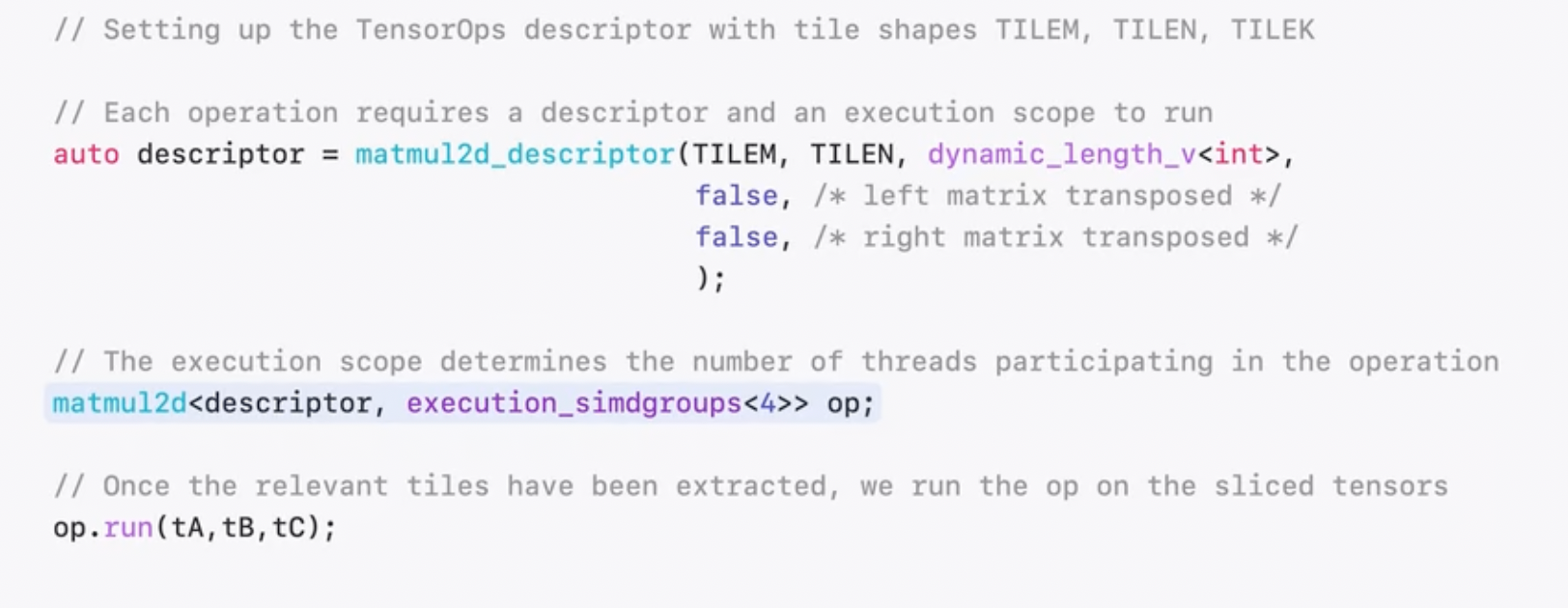
HOWTO use NAX: TensorOps
- MatMul + Conv
- Same API across M1–M5
- Uses NAX on M5 and A19 Pro
- Can be mixed with other programmable Metal shader code4
Important features:
| Version | Feature |
|---|---|
| 26.1 | BF16 support |
| 26.3 | Cooperative tensors as inputs, enabling a user-defined prologue for custom dequantization |
| 26.4 | 4-bit / 8-bit integer support |
| 27 | Micro-scaling MXFP4 / MXFP8 / FP8 / 2-bit integer support |
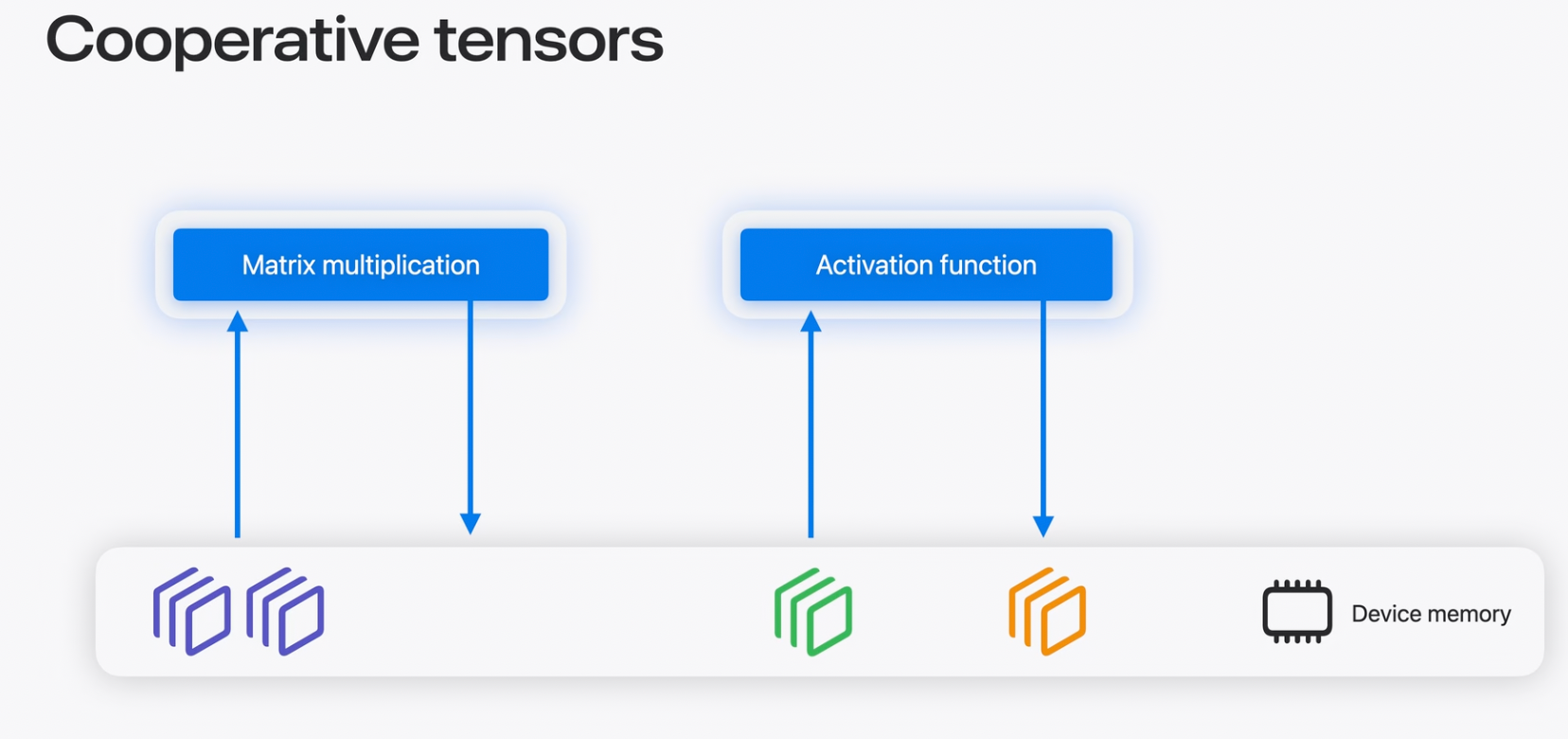
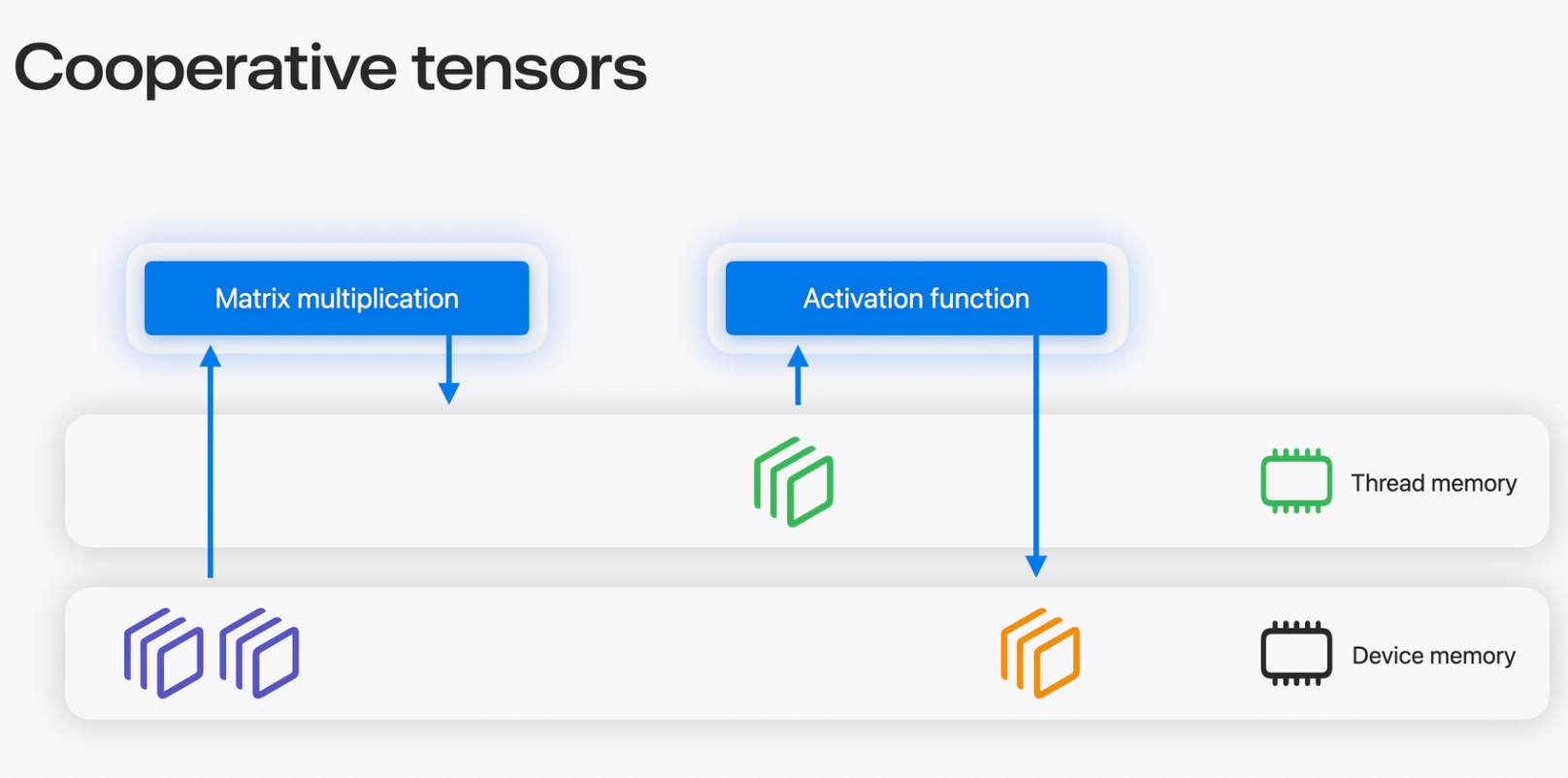
Cooperative tensors
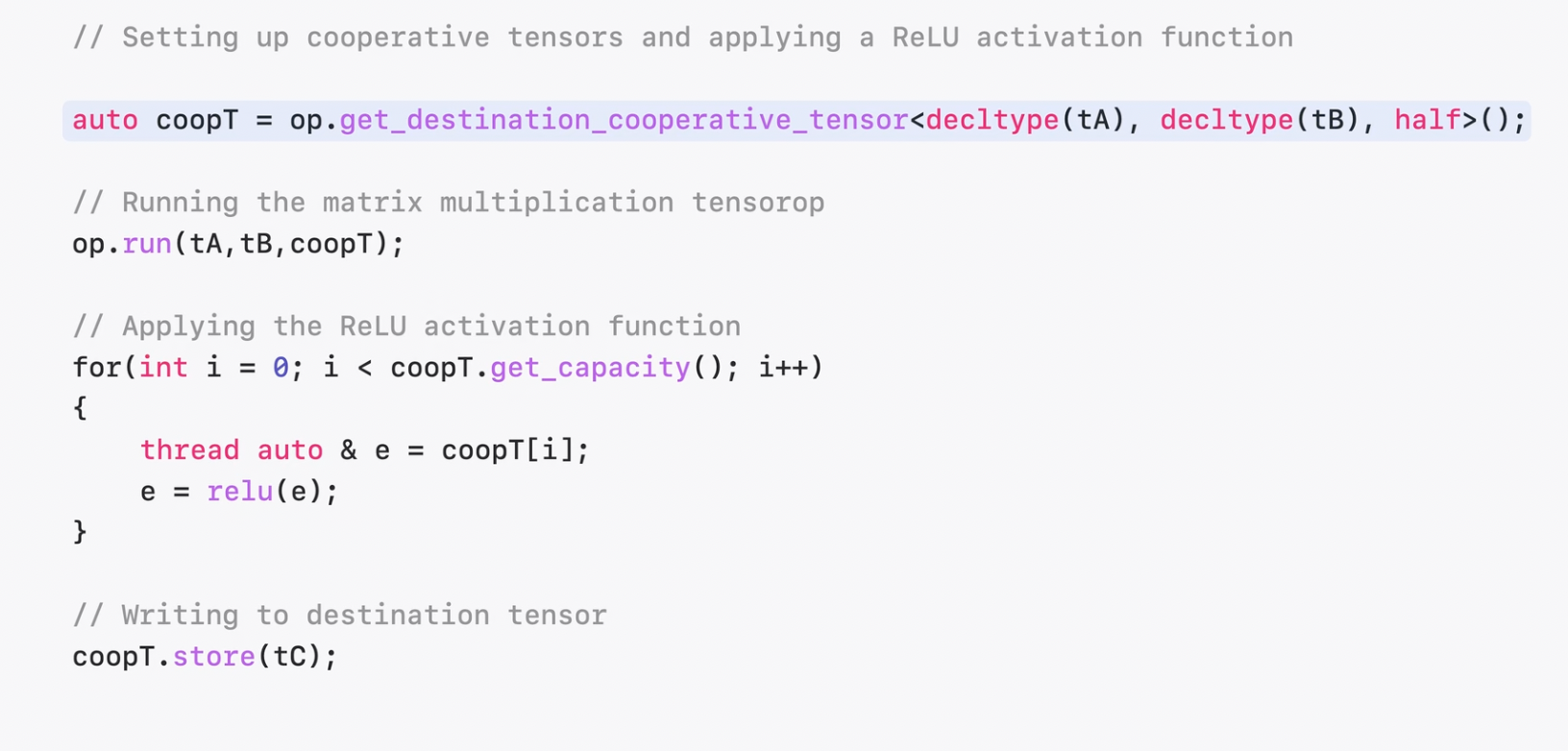
Cooperative tensors keep a MatMul result in fast thread memory for in-place post-processing.4
How to:
MLX Metal GEMM: from dispatch to NAX
Source snapshot:
3a62199. The following blocks are source excerpts, not standalone programs; omitted arguments use....8
1. Layer to dispatch
Linear.__call__ chooses addmm when bias is present and matmul otherwise:9
if "bias" in self:
    x = mx.addmm(self["bias"], x, self["weight"].T)
else:
    x = x @ self["weight"].T
In Matmul::eval_gpu, layout preparation is followed by shape-based routing:
if (M == 1 && N == 1 && batch_size_out == 1 &&
    a.flags().row_contiguous && b.flags().row_contiguous &&
    a.dtype() != complex64) {
  return dot_product(...);
}

if (!a_transposed && b_transposed && gemv_wide(...)) {
  return;
}

if (std::min(M, N) == 1) {
  return gemv(...);
}

return steel_matmul(...);
This separates dot products, narrow/wide GEMV cases, and Steel GEMM.
Within Steel, a long reduction dimension K can select a split-K kernel. The regular NAX path below is one branch, not the implementation for every matrix multiplication.
2. Select a Metal kernel
NAX eligibility checks both the platform and dtype:
bool use_nax = metal::is_nax_available() &&
    !issubdtype(a.dtype(), complexfloating) &&
    (env::enable_tf32() || a.dtype() != float32);
is_nax_available() checks build support, OS version (26.2 or newer), and GPU architecture. FP16 passes the dtype filter, but still needs a supported platform.10
For regular NAX GEMM, MLX chooses a threadgroup tile bm by bn, reduction block bk, and SIMD-group arrangement wm by wn:
int bm = 128, bn = 128, bk = 512;
int wm = 4, wn = 4;

char devc = d.get_architecture().back();
if (devc == 's' || devc == 'c' || devc == 'd') {
  bk = (K >= 8192 && K > (M + N)) ? 64 : 256;
  bm = 64;
  wm = 2;
}

kname << "steel_gemm_fused_nax_"
      << (transpose_a ? 't' : 'n')
      << (transpose_b ? 't' : 'n')
      << "_" << type_to_name(a)
      << "_" << type_to_name(out)
      << "_bm" << bm << "_bn" << bn << "_bk" << bk
      << "_wm" << wm << "_wn" << wn;
The base kernel name encodes transpose flags, dtypes, and tile sizes. Batch, alignment, and epilogue flags further specialize the cached pipeline.
Without NAX, regular Steel GEMM uses steel_gemm_fused_.... Its initial tile is bm = 64, bn = 64, bk = 16, with wm = wn = 2; GEMM_TPARAM_MACRO then applies device/shape tuning.11
3. Map tiles to threadgroups
The output tile counts are rounded up, then swizzled for launch. Shown here is regular NAX GEMM; the non-NAX variant uses get_steel_gemm_fused_kernel for pipeline lookup:
int tn = (N + bn - 1) / bn;
int tm = (M + bm - 1) / bm;

// GEMMParams retains the logical tile counts and matrix strides.
int tile = 1 << swizzle_log;
tm = (tm + tile - 1) / tile;
tn = tn * tile;

MTL::Size group_dims = MTL::Size(32, wn, wm);
MTL::Size grid_dims = MTL::Size(tn, tm, batch_size_out);

auto& compute_encoder = metal::get_command_encoder(s);
auto kernel = get_steel_gemm_fused_nax_kernel(...);
compute_encoder.set_compute_pipeline_state(kernel);
compute_encoder.set_input_array(a, 0);
compute_encoder.set_input_array(b, 1);
compute_encoder.set_output_array(out, 3);
compute_encoder.set_bytes(params, 4);
// Optional bias/epilogue and batch bindings omitted.
compute_encoder.dispatch_threadgroups(grid_dims, group_dims);
swizzle_log comes from a device/shape heuristic. Each threadgroup has 32 * wn * wm threads; GEMMParams carries sizes, strides, and the swizzle needed to map the launch back to output tiles. Alignment flags select handling for partial tiles.
The binding indices match the Metal kernel’s [[buffer(0)]] input A, [[buffer(1)]] input B, [[buffer(3)]] output D, and [[buffer(4)]] parameters. MLX’s dispatch wrapper inserts dependency barriers and records the native Metal dispatch:12
void CommandEncoder::dispatch_threadgroups(
    MTL::Size grid_dims, MTL::Size group_dims) {
  maybeInsertBarrier();
  buffer_ops_++;
  get_command_encoder()->dispatchThreadgroups(grid_dims, group_dims);
}
This encodes work into a command buffer. MLX submits it with buffer_->commit() when it flushes the stream; dispatch itself does not wait for GPU completion.
Inside the NAX kernel, wm/wn partition the output tile, not the reduction dimension. The JIT passes host values bm, bn, bk, wm, wn as template arguments BM, BN, BK, WM, WN. Metal supplies simd_group_id via [[simdgroup_index_in_threadgroup]]; the kernel uses it to select a sub-tile:13
// steel_gemm_fused_nax.h: after batch and threadgroup tile offsets.
constexpr short SM = BM / WM;
constexpr short SN = BN / WN;
constexpr short TM = SM / 16;
constexpr short TN = SN / 16;

const short tm = SM * (simd_group_id / WN);
const short tn = SN * (simd_group_id % WN);

A += transpose_a ? tm : (tm * params->lda);
B += transpose_b ? (tn * params->ldb) : tn;
D += tm * params->ldd + tn;

NAXTile<AccumType, TM, TN> Dtile;
// gemm_loop<T, SM, SN, ...> accumulates this tile across K.
For BM = BN = 128 and WM = WN = 4, one threadgroup has 16 SIMD-groups (512 threads). Each group computes a 32 x 32 output sub-tile: group 5 starts at (tm, tn) = (32, 32) within the threadgroup tile. With TM = TN = 2, its accumulator contains a 2 x 2 grid of 16 x 16 fragments. The inner (16, 32, 16) operation below is a compute step, not the whole group’s tile. Kernel-local tm/tn are element offsets, unlike the host’s launch tile counts.
4. Load, compute, write
Non-NAX: shared staging, SIMD-group MMA, global store. The kernel stages input tiles in threadgroup memory before computing:11
// steel_gemm_fused.h: aligned main loop; offsets and epilogue omitted.
threadgroup T As[gemm_kernel::tgp_mem_size_a];
threadgroup T Bs[gemm_kernel::tgp_mem_size_b];
thread mma_t mma_op(simd_group_id, simd_lane_id);
thread loader_a_t loader_a(A, params->lda, As, simd_group_id, simd_lane_id);
thread loader_b_t loader_b(B, params->ldb, Bs, simd_group_id, simd_lane_id);

for (int k = 0; k < gemm_k_iterations; k++) {
  threadgroup_barrier(mem_flags::mem_threadgroup);
  loader_a.load_unsafe();
  loader_b.load_unsafe();
  threadgroup_barrier(mem_flags::mem_threadgroup);
  mma_op.mma(As, Bs);
  loader_a.next();
  loader_b.next();
}
threadgroup_barrier(mem_flags::mem_none);
return mma_op.store_result(D, params->ldd);
mma_op.mma loads fragments from As/Bs and reaches this primitive in mma.h:
METAL_FUNC static constexpr void mma(
    thread mat_type& D, thread mat_type& A,
    thread mat_type& B, thread mat_type& C) {
  simdgroup_multiply_accumulate(D, A, B, C);
}
Here mat_type is metal::simdgroup_matrix<T, 8, 8>: each of 32 threads holds two elements per fragment. This is the non-NAX matrix primitive, distinct from the NAX cooperative-tensor operation below.
NAX: private tiles, cooperative-tensor MMA, global store.
Inside steel/gemm/nax.h, the inner operation uses a (16, 32, 16) descriptor at SIMD-group scope. Cooperative tensors hold operand and accumulator fragments distributed across the group:1415
A fragment is 16x16, so 32 threads will hold kElemsPerFrag = 16x16/32 = 8
However this kernel is 16x32x16 (M, N, K), so it requires 1 A fragment(tile), 2 B fragments, 2 C fragments
constexpr auto desc = mpp::tensor_ops::matmul2d_descriptor(
    16, 32, 16, transpose_a, transpose_b, true,
    mpp::tensor_ops::matmul2d_descriptor::mode::multiply_accumulate);

mpp::tensor_ops::matmul2d<desc, metal::execution_simdgroup> gemm_op;

auto ct_a = gemm_op
    .template get_left_input_cooperative_tensor<AType, BType, CType>();
auto ct_b = gemm_op
    .template get_right_input_cooperative_tensor<AType, BType, CType>();
auto ct_c = gemm_op.template get_destination_cooperative_tensor<
    metal::remove_addrspace_t<decltype(ct_a)>,
    metal::remove_addrspace_t<decltype(ct_b)>,
    CType>();

for (short i = 0; i < kElemsPerFrag; i++) {
  ct_a[i] = A[i];
  ct_b[i] = Bn0[i];
  ct_b[kElemsPerFrag + i] = Bn1[i];
  ct_c[i] = Cn0[i];
  ct_c[kElemsPerFrag + i] = Cn1[i];
}

gemm_op.run(ct_a, ct_b, ct_c);

for (short i = 0; i < kElemsPerFrag; i++) {
  Cn0[i] = ct_c[i];
  Cn1[i] = ct_c[kElemsPerFrag + i];
}
run performs the multiply-accumulate using initialized fragments; the final loop copies the accumulator back to MLX’s fragment layout.
Cn0[i] = ct_c[i] copies a private fragment, not an output buffer. In this helper, Cn0/Cn1 are declared thread dtype_frag_t<CType>&; A and Bn0/Bn1 are const thread references. dtype_frag_t<U> is a vector of eight elements per thread.14
| Storage in the source | Example | Meaning |
|---|---|---|
thread |
Inner A, Bn0, Cn0 fragments |
Per-thread private values, normally register-resident |
threadgroup |
Non-NAX As / Bs |
Shared scratchpad for threads in one threadgroup |
device |
Outer kernel A / B / D pointers |
Global input/output buffers |
The inner fragment named A is not the outer kernel’s device pointer named A. thread does not guarantee physical register allocation: the compiler can spill. Likewise, a device access can hit cache rather than DRAM.16
The regular NAX path loads from device buffers directly into private tiles, then stores the completed tile through the output device pointer. These excerpts show the missing input/output boundary:17
// gemm_nax.h: aligned input loads inside the reduction loop.
// A and B are const device T*.
Atile.load(A + A_offset, lda);
Btile.load(B + B_offset, ldb);
tile_matmad_nax(
    Dtile, Atile, metal::bool_constant<transpose_a>{},
    Btile, metal::bool_constant<transpose_b>{});

// steel_gemm_fused_nax.h: after gemm_loop and any epilogue.
// D is device T*; partial output tiles use store_safe instead.
Dtile.store(D, int(params->ldd));
So the regular non-NAX path explicitly stages through threadgroup memory, while this NAX path does not use that staging step. In both, fragment assignment and global-buffer storage are separate operations.
This is the GPU control surface visible in MLX: dispatch, tiling, launch geometry, and matrix primitives. The Metal compiler still owns instruction lowering.
Profiling & Debugging
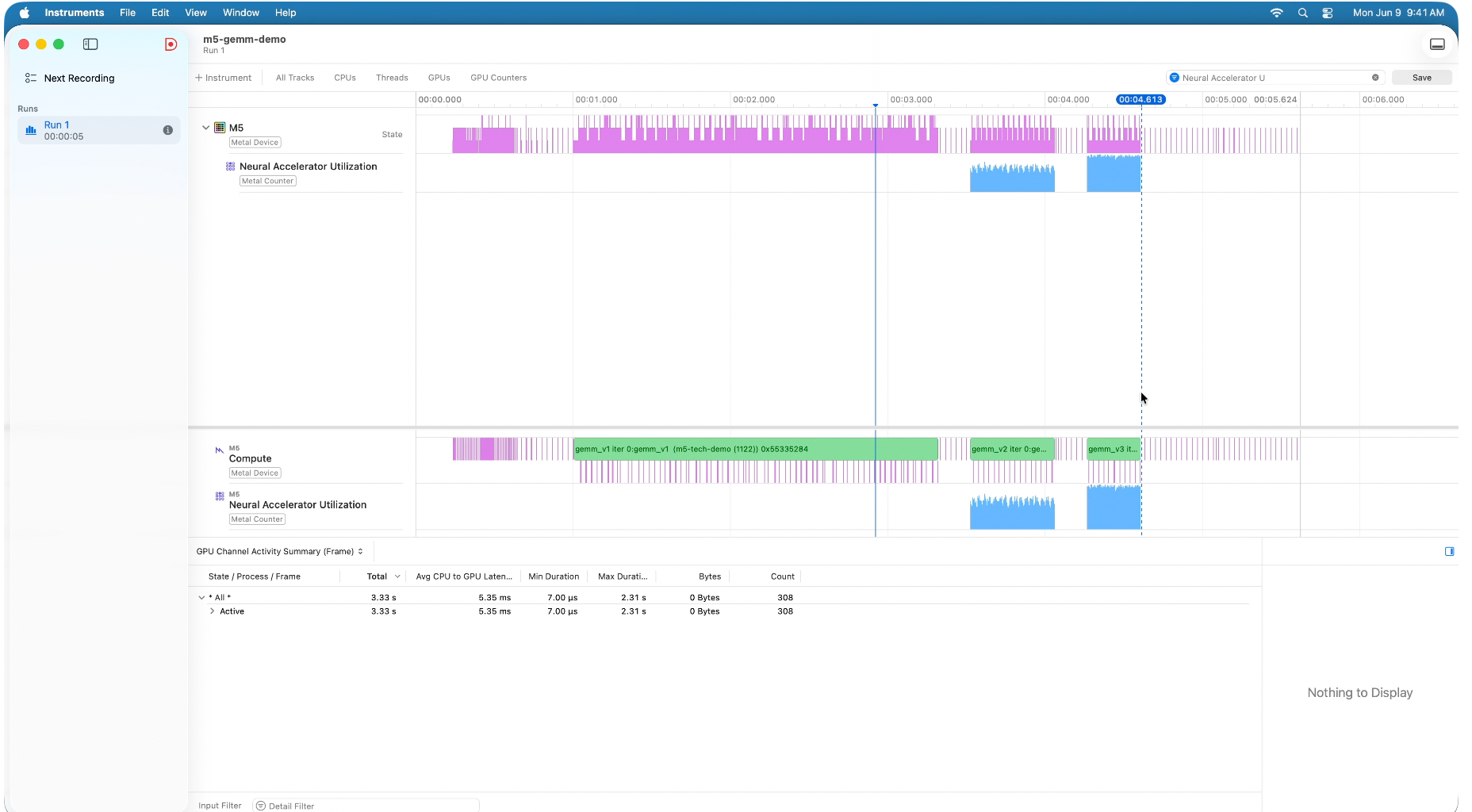
Model level: Instruments
Similar to Nsight Systems
Instruments shows CPU, GPU, memory, display, command-buffer execution, and performance counters on a system timeline.4
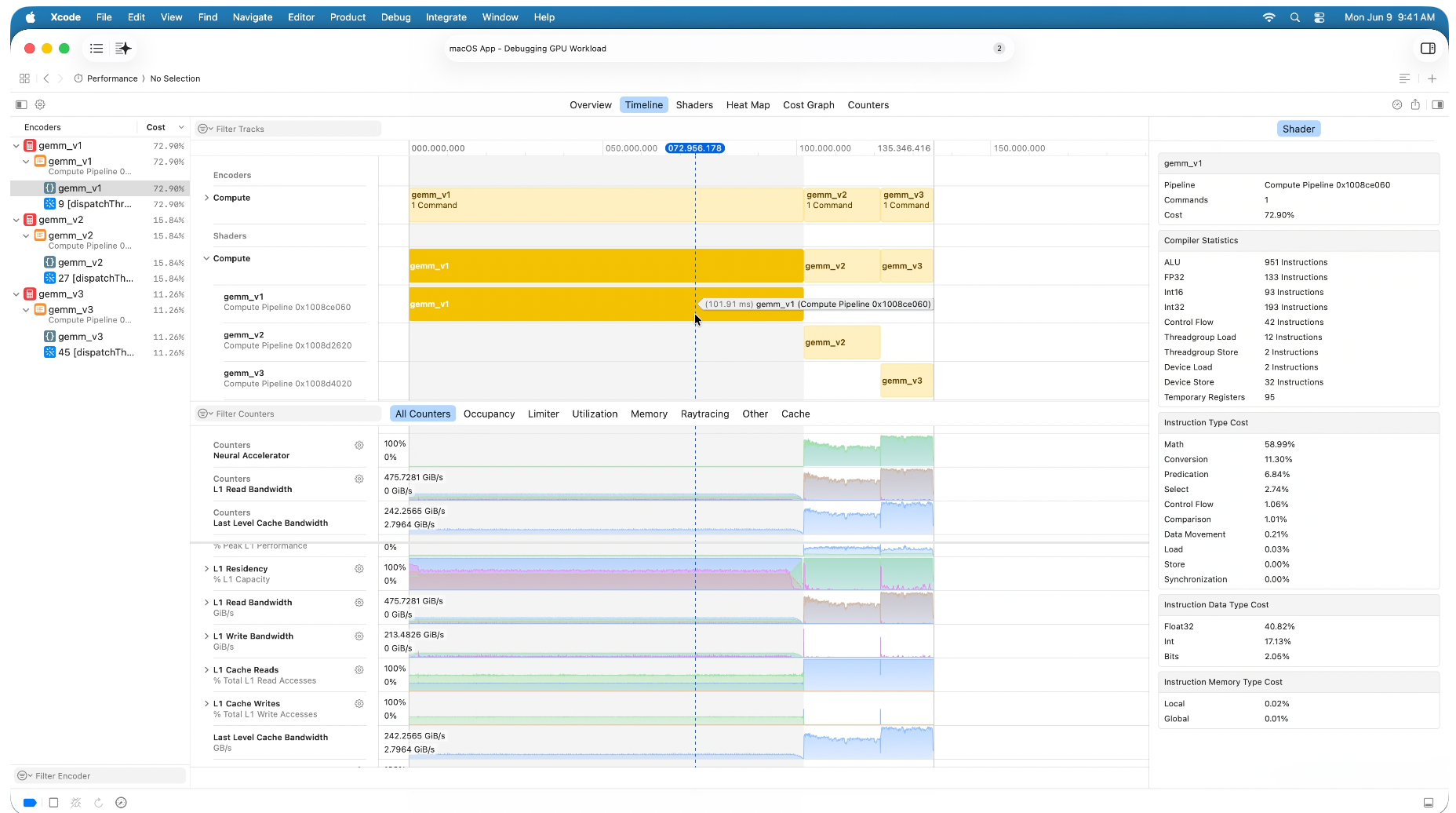
Kernel level: Xcode Metal debugger
Similar to Nsight Compute
GPU trace replay isolates work for cost graphs, counters, register use, divergence, and instruction analysis.4
References
-
Apple Neural Engine: A Complete Guide, Execution model: reverse-engineered ANE execution context; not an Apple specification. ↩
-
Kaiyu Shi, local M5 Max ANE throughput measurement, September 9, 2026: 25 TFLOPS at FP16 and 50 TOPS at INT8; measured results rather than Apple-published peak specifications. ↩
-
Apple Developer, Explore GPU advancements in M3 and A17 Pro, Tech Talks: Apple family 9 shader cores, Dynamic Caching, flexible on-chip memory, dynamic occupancy, hardware ray tracing, and mesh shading. ↩ ↩2 ↩3
-
Apple Developer, Accelerate your machine learning workloads with the M5 and A19 GPUs, Tech Talks: per-shader-core Neural Accelerators, TensorOps, cooperative tensors, Metal System Trace, and Xcode Metal debugger. ↩ ↩2 ↩3 ↩4 ↩5 ↩6
-
Apple, Apple unleashes M1, November 2020, reporting 2.6 TFLOPS for M1; Philip Turner, Apple GPU microarchitecture benchmarks, FP32 FLOPS, core-count, and clock tables through Apple8; HubWeb, A-series and M-series comparison tables, used for later GPU width and clock inputs. Later values are derived estimates, not Apple-published peak specifications. ↩
-
ggml-org,
llama.cppApple Silicon performance discussion: M5 Max 40-core legacy Metal reports by Hassan-A-K and CSendner, plus the accepted Tensor API result. All use Llama 2 7B,pp512,tg128, and full GPU offload; the legacy pair is averaged in the table. ↩ -
ggml-org,
llama.cppPR #16634: initial Metal 4 Tensor API support and its M5 branch-versus-main benchmark, October-November 2025. The pull request added Tensor API detection, an opt-out environment variable, and M5-or-later gating. ↩ -
MLX,
Matmul::eval_gpu, Steel dispatch, and regular NAX kernel setup. ↩ -
MLX,
Linear.__call__. ↩ -
MLX,
is_nax_available(). ↩ -
MLX, regular non-NAX dispatch,
steel_gemm_fused.haligned loop, andmma.hSIMD-group primitive. ↩ ↩2 -
MLX, Metal dispatch, command-buffer submission, and stream finalization. ↩
-
MLX, JIT template arguments and NAX SIMD-group tile mapping. ↩
-
MLX,
nax.hfragment types and cooperative-tensor multiply-accumulate. ↩ ↩2 -
Apple, Metal Shading Language Specification, tensor operations; see also “Optimize custom machine learning operations with Metal tensors”. The linked specification is updated by Apple; MLX excerpts above are pinned to a commit. ↩
-
Apple, “Learn performance best practices for Metal shaders”, address spaces and caching; Metal Shading Language Specification, address-space semantics. ↩
-
MLX,
gemm_loopdevice loads and NAX output store. ↩
Discussion
Comments