Who uses watermark?
Public status checked on October 15, 2026. Date shows launch timing; — means no confirmed launch date.
| Provider / framework | Date | Scope | APIs | Watermark algorithm |
|---|---|---|---|---|
| May 14, 2024 | Gemini apps | Text API: no watermark; detection: open-source tools.123 | SynthID-Text: tournament sampling.4 | |
| Anthropic | August 2026 | Supported Claude models | Generation: supported Claude APIs; detection: private preview.56 | A version of SynthID-Text; production keys are private.5 |
| OpenAI | October 5, 2026 | Selected models | Generation: API opt-in; detection: restricted access.7 | textGrain.7 |
| vLLM | September 24, 2026 | Self-hosted inference | Generation: Python / OpenAI-compatible APIs; detection: local utilities.89 | Keyed Gumbel-max.8 |
| SGLang | — | Self-hosted inference | Generation: native / OpenAI-compatible APIs; detection: Python.10 | Keyed Aaronson–Gumbel selection; optional dual-key mode.10 |
What is watermark?
Identify whether a passage was generated by my model.
Why do we use watermark?
- Regulation: EU Code of Practice on Transparency of AI-Generated Content
- Anti-LLMs: paper, homework, others
How to add watermark?
Naive way
It's a good day!

Authored by: CLAUDE
It's |CLAUDE| a |CLAUDE| good |CLAUDE| day |CLAUDE|!
Generative watermark (pseudo-random sampling)

Red-Green light (simple but not aligned with original LLM output)
- Generate more green light words, less red light words
- drawbacks:distortion
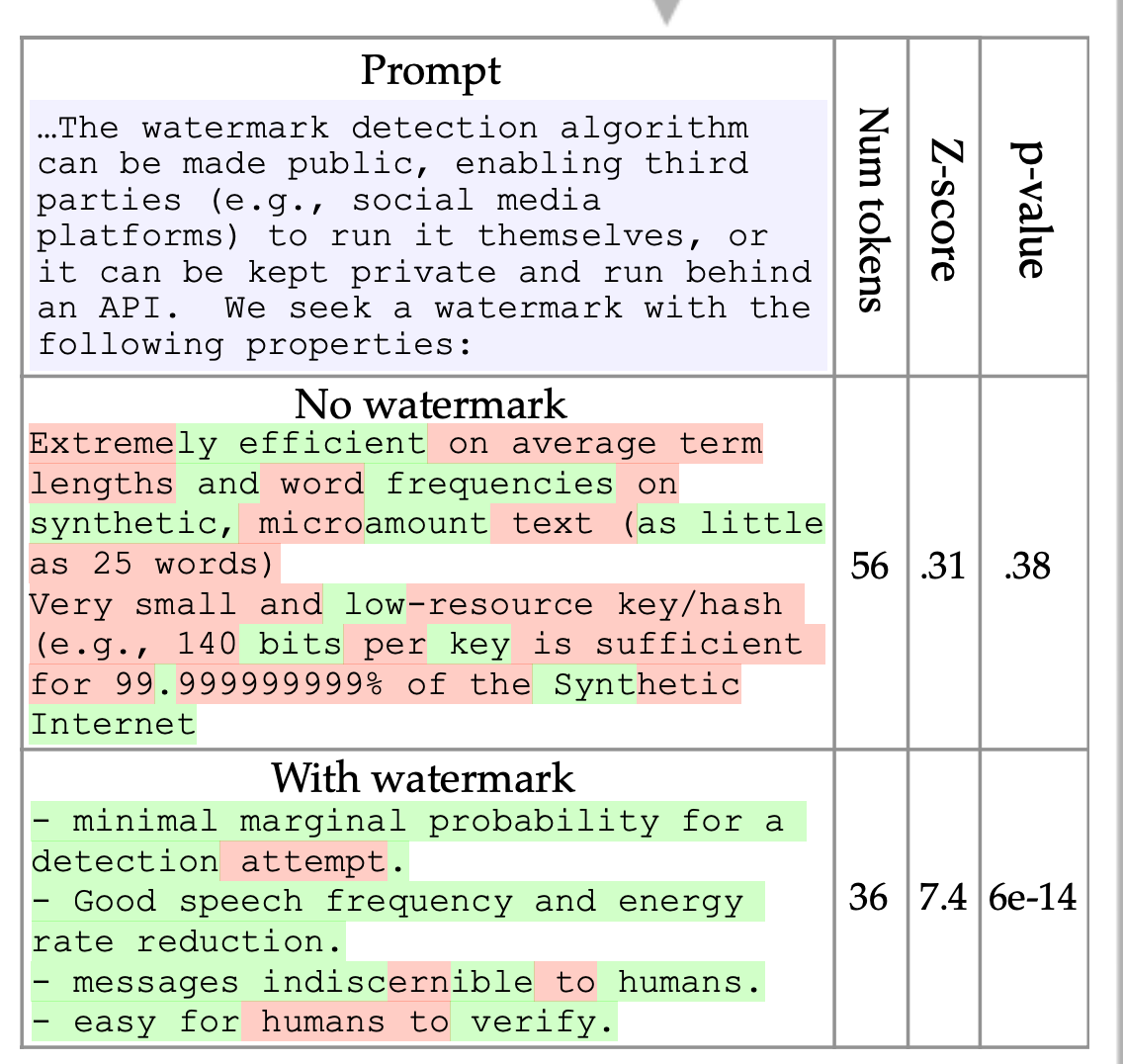
Gumbel-max sampling
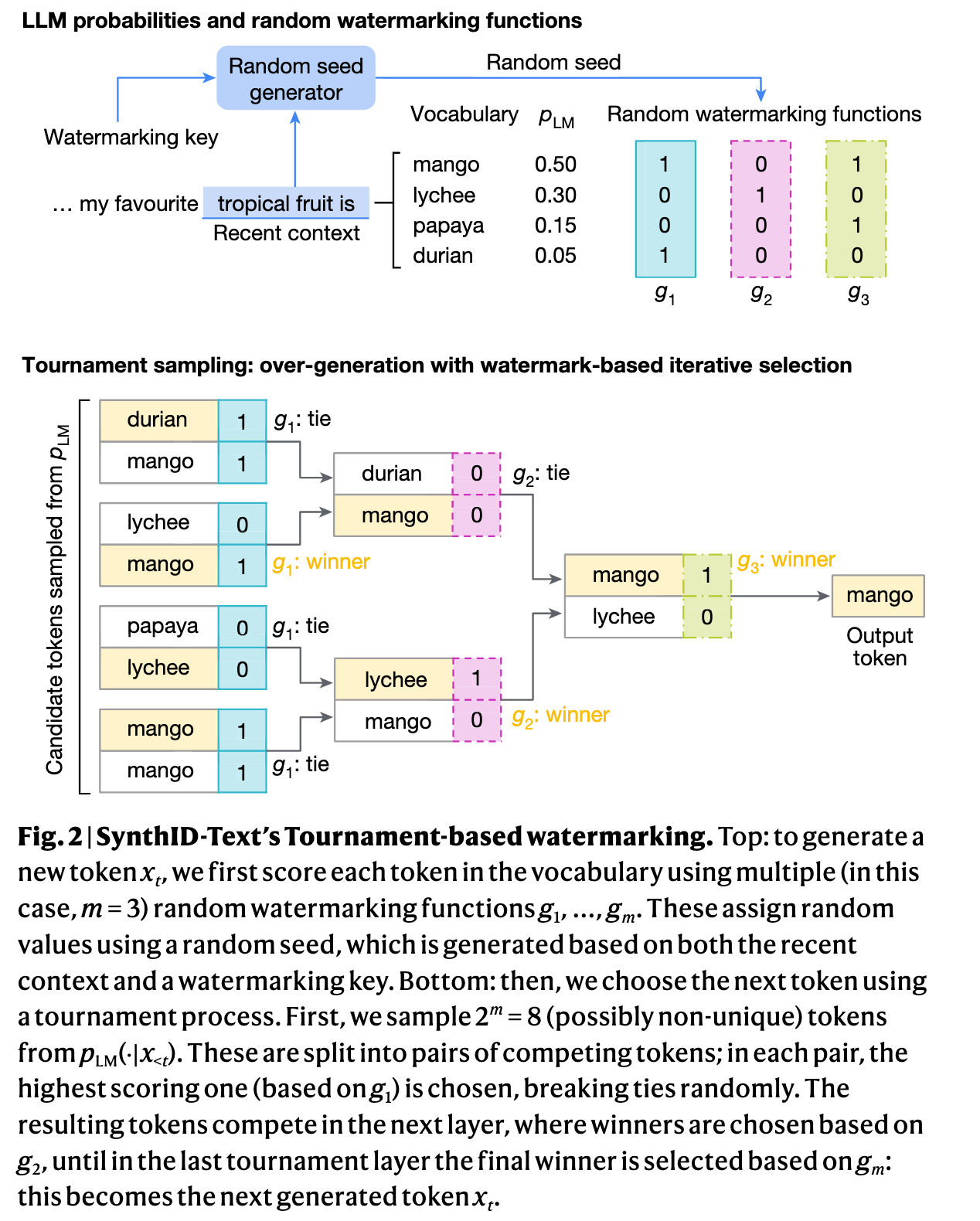
kaiyu, synchronizing token highlights and cumulative evidence. English narration; approximately 2 minutes 16 seconds.SynthID-Text (tournament sampling)
Most widely used methods (for better detection performance)
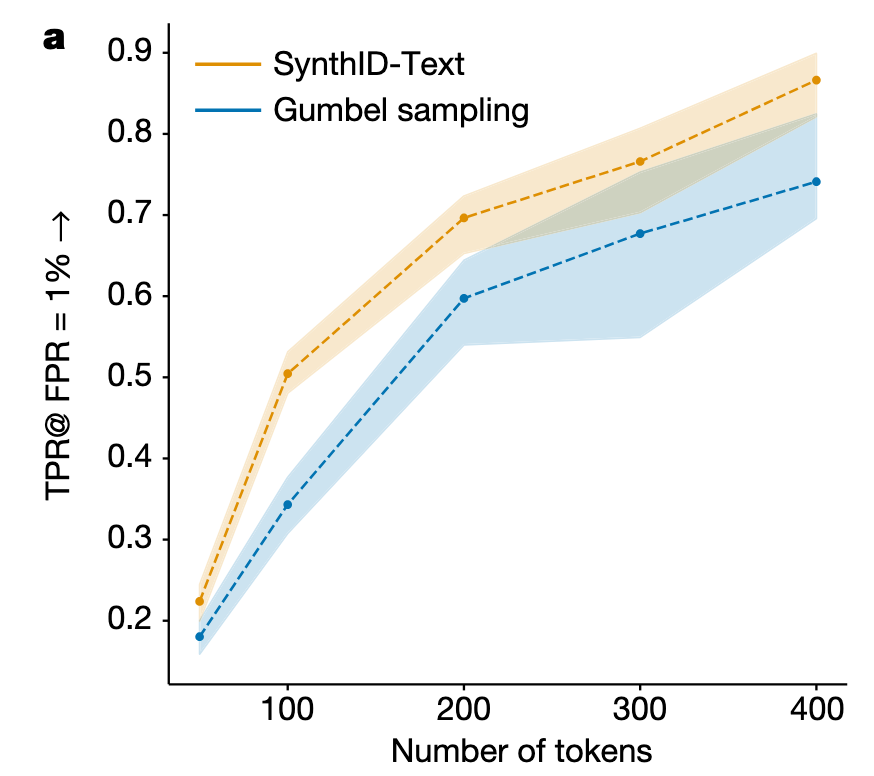
In-conclusion:
- Higher entropy leads to better watermark
- trade-offs between distortion and detectability
Challenges in Inference Systems
- Gumbel-max sampling overhead (negligible)
- Speculative Decode (Rejection sampling versus Gumbel-max sampling)
FAQs
Does watermarking affect LLM’s output?
No in theory.
No in Google’s 20 million Gemini thumbs-up and thumbs-down A/B tests.4
Anthropic reports no observed impact on content, creativity, or readability in its internal testing.5
References
-
Google DeepMind, Watermarking AI-generated text and video with SynthID, May 14, 2024; Gemini app and web deployment announcement. ↩
-
Google AI Developers Forum, Trey Nguyen, Does Gemini API text output carry SynthID watermarking?, August 5, 2026; API text scope in the support response. ↩
-
Google DeepMind, SynthID Text, public implementation for self-hosted models; inspected October 15, 2026. ↩
-
Sumanth Dathathri et al., Scalable watermarking for identifying large language model outputs, Nature 634, 818–823, October 23, 2024; Figs. 1–2, detection comparison and production evaluation. Paper figures are licensed CC BY 4.0; the overview was redrawn and extended with the ordinary random seed generator. ↩ ↩2 ↩3 ↩4 ↩5
-
Anthropic, How Claude’s text watermark works, August 14, 2026; updated September 1, 2026 for detector access. ↩ ↩2 ↩3
-
Anthropic, How Claude marks AI-generated content, model/surface coverage and partner rollout status inspected October 15, 2026. ↩
-
OpenAI, Our approach to EU text provenance rules, October 5, 2026; API opt-in, EU rollout, textGrain and restricted detector access. ↩ ↩2
-
Raphaël Rialland, Simon Veitner and Tomas Ruiz, Watermarking in vLLM, September 24, 2026. ↩ ↩2
-
vLLM, Text watermarking, configuration, request surfaces and detection; inspected October 15, 2026. ↩
-
SGLang, Text watermarking design,
mainsnapshot71a17db, inspected October 15, 2026; source-level evidence, not a release announcement. ↩ ↩2 -
Scott Aaronson, Anthropic’s LLM watermarking, author commentary linked in the outline. ↩
-
Zvi Mowshowitz, AI Text Watermarking Is Free And Good, community commentary linked in the outline. ↩
Discussion
Comments