Apple Silicon has two major AI accelerators: the Apple Neural Engine (ANE) and the GPU. Their useful distinction is the programming interface: ANE execution is compiler-managed; the GPU also exposes programmable kernels.
Hardware
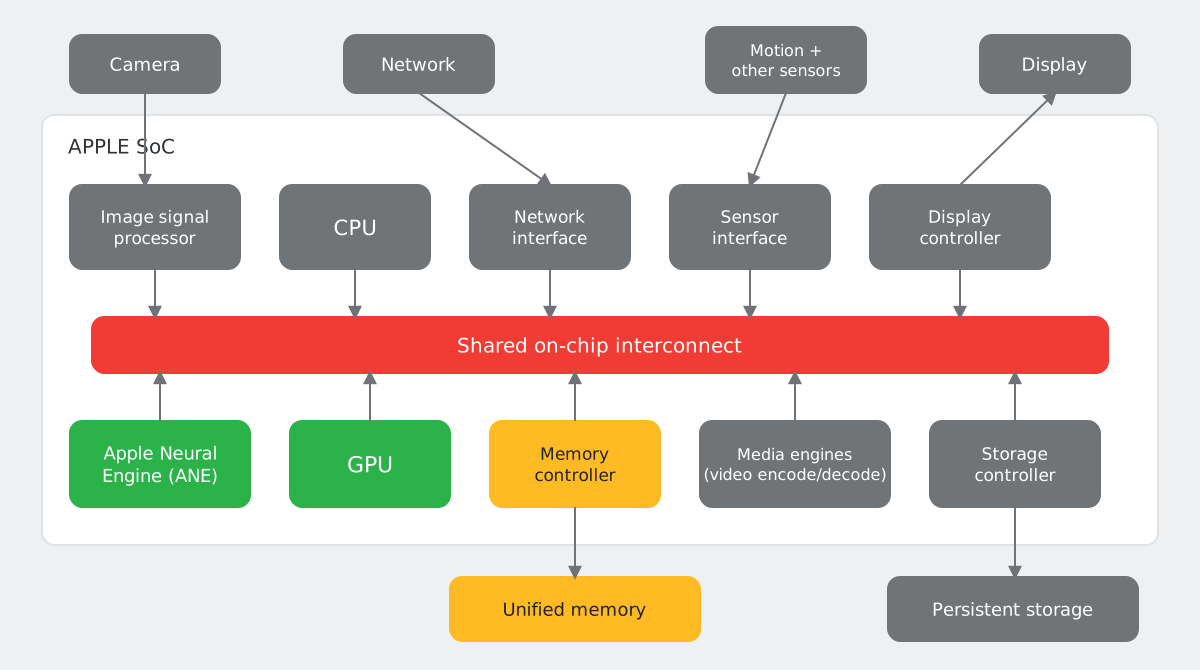
Both accelerators exist on iPhone and Mac. The Neural Accelerators inside recent GPU cores are separate from the ANE.12
| Hardware | A19 Pro (iPhone 17 Pro) | M5 Max (top configuration) |
|---|---|---|
| GPU cores | 6 | 40 |
| Neural Accelerators in GPU | Yes | Yes |
| ANE cores | 16 | 16 |
| Unified memory bandwidth | 77 GB/s (non-official) | 614 GB/s |
| GPU FP16 throughput | 12 TFLOPS (peak-guess) | 43 TFLOPS (measured) / 65 TFLOPS (peak-guess) |
| ANE throughput | FP16: 25 TFLOPS (peak-guess) | FP16: 25 TFLOPS / INT8: 50 TOPS (measured) |
The M5 Max ANE numbers are local measurements, not Apple-published peak specifications.3
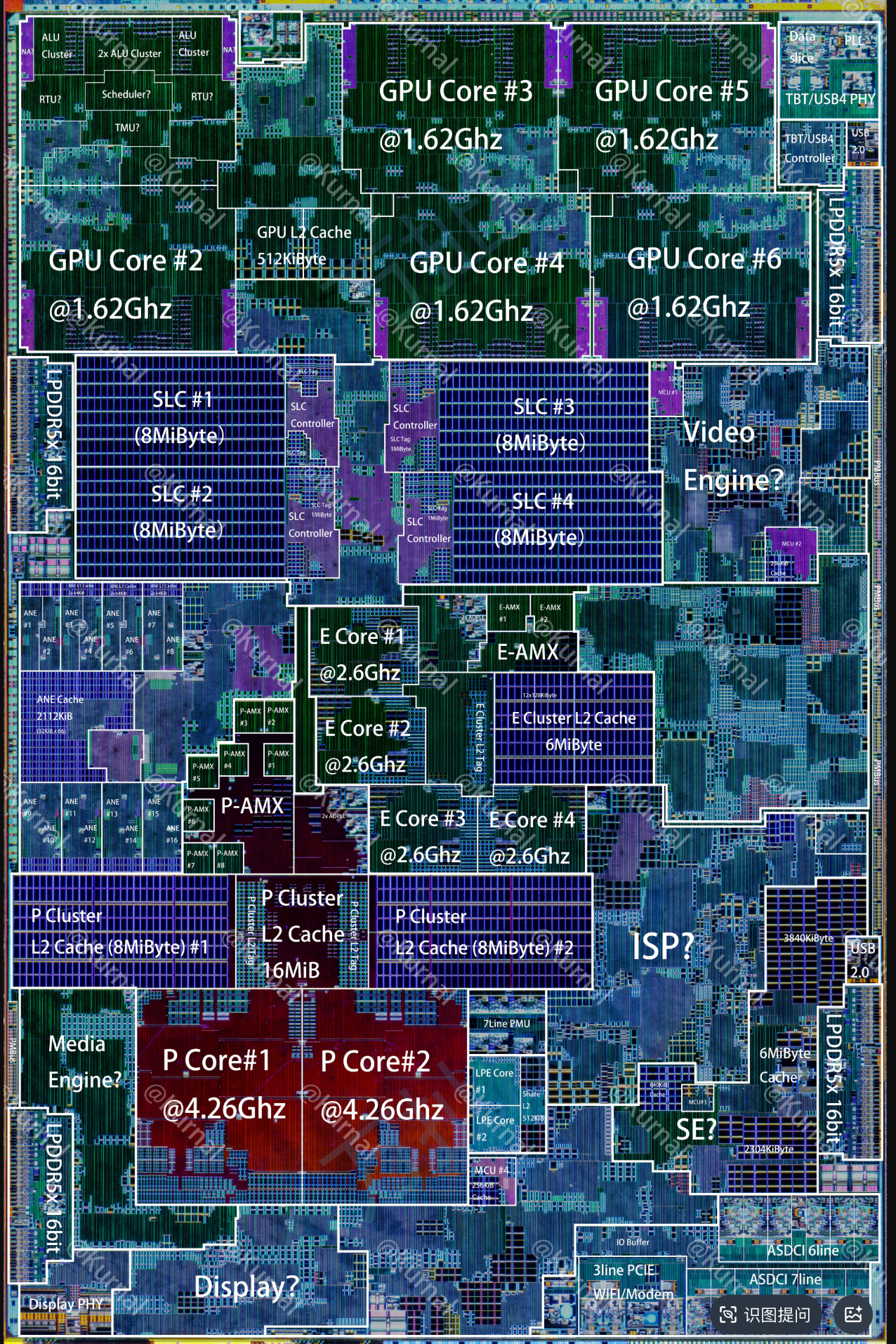
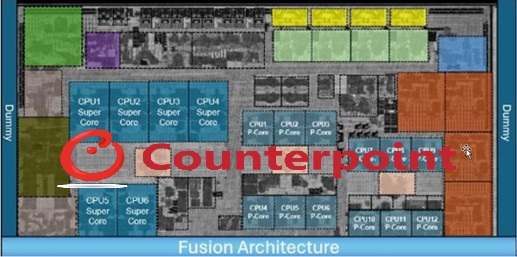
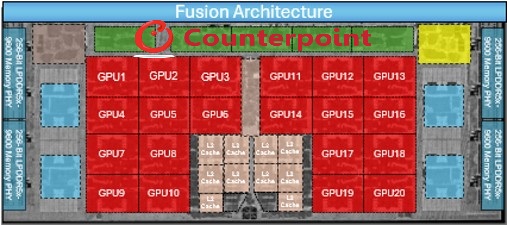
Die views: A19 Pro and M5 Pro
| Dimension | ANE | GPU |
|---|---|---|
| Hardware role | Dedicated neural-network accelerator | Graphics Rendering + Parallel Computation |
| Typical use | Low-power inference | Inference, training, custom tensor programs |
| Programming unit | Model graph or layer | Tensor op, kernel, layout, command buffer |
| Public access | CoreML | PyTorch MPS, MLX, Metal; also model frameworks |
| Custom kernels | No public ANE kernel API | Metal kernels |
| Ops and dtypes | Constrained by compiler and device support | Constrained by framework, Metal, and GPU generation |
For ANE internals beyond the public API, Bryngelson’s reverse-engineering study separates measured results from inferred and predicted behavior.4
Software Stack
Model frameworks choose placement; GPU frameworks expose tensor operations and kernels.
| Entry point | Execution path | Control |
|---|---|---|
| Core ML / Core AI | Compiled model -> CPU / GPU / ANE | Model deployment and hardware placement |
PyTorch mps |
PyTorch ops -> MPS / Metal -> GPU | Tensor operations |
| MLX | Array graph -> Metal backend -> GPU (or CPU backend) | Operations and custom kernels |
| Metal | Kernels and command buffers -> GPU | Kernel implementation and dispatch |
Core ML / Core AI represents Apple’s model-deployment layer. Core AI evolves that role with updated runtime and export APIs; the example below uses the Core ML coremltools API.5
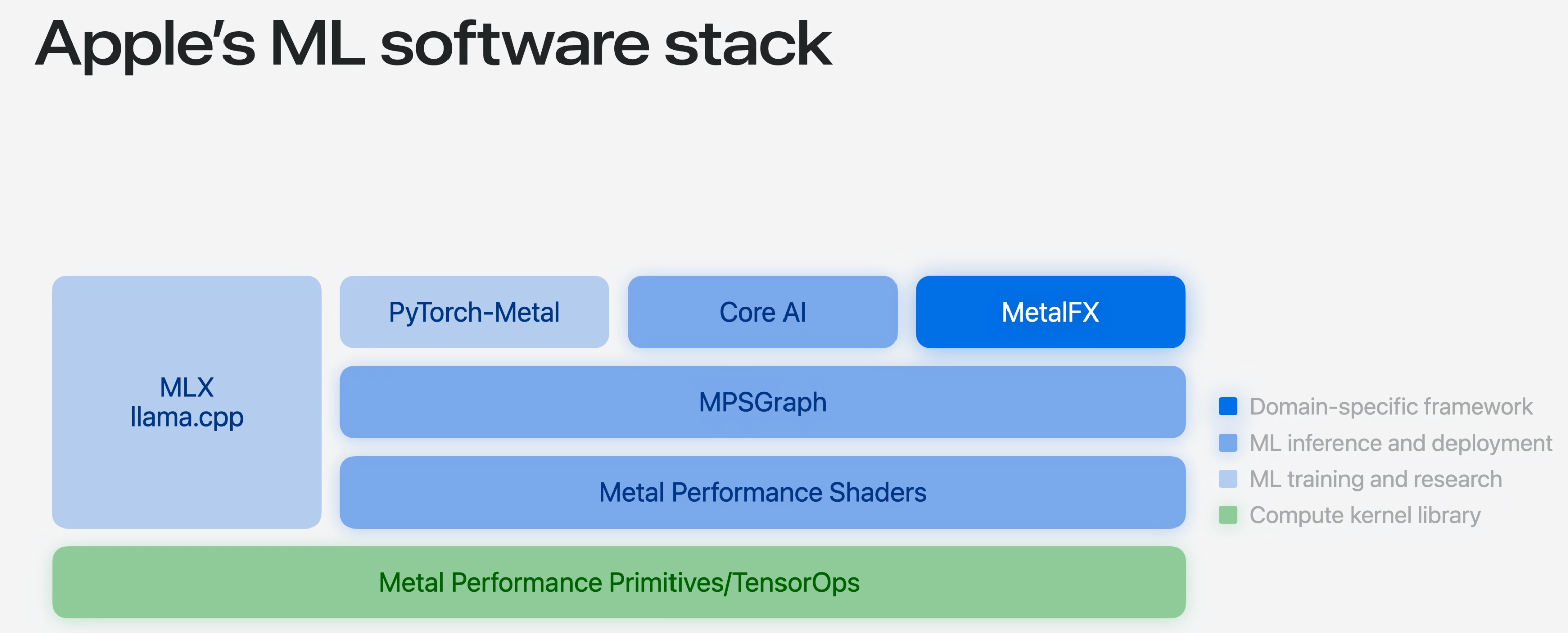
mps device to its cuda device; Metal to CUDA; Metal tensor operations to matrix primitives used by CuTe/Triton. These describe abstraction levels, not API equivalence.Core ML’s CPU_AND_NE permits CPU and ANE, excluding GPU; CPU_AND_GPU excludes ANE; ALL permits all three. These are allowed targets, not guarantees that an operation will use a particular accelerator.6
Minimal Runnable Examples
Tested on an M1 Pro, macOS 26.6, Python with coremltools 8.3.0, torch 2.8.0, and mlx 0.32.1. Outputs below are execution checks, not performance measurements. The linked NAX source walkthrough targets newer GPUs and was not measured on this M1 Pro.
ANE path: PyTorch to Core ML
import coremltools as ct
import numpy as np
import torch


class TinyLinear(torch.nn.Module):
    def __init__(self):
        super().__init__()
        self.proj = torch.nn.Linear(128, 64)

    def forward(self, x):
        return self.proj(x)


def run_coreml(model, example, package_name):
    traced = torch.jit.trace(model.eval(), example)
    mlmodel = ct.convert(
        traced,
        inputs=[ct.TensorType(name="x", shape=example.shape)],
        compute_units=ct.ComputeUnit.CPU_AND_NE,
        minimum_deployment_target=ct.target.macOS13,
    )
    mlmodel.save(f"{package_name}.mlpackage")
    print(type(mlmodel).__name__)

    result = mlmodel.predict({"x": example.numpy().astype(np.float32)})
    for name, value in result.items():
        print(name, value.shape, value.dtype)

    # Compute-plan inspection requires macOS 14.4 or newer.
    plan = ct.models.compute_plan.MLComputePlan.load_from_path(
        mlmodel.get_compiled_model_path(),
        compute_units=ct.ComputeUnit.CPU_AND_NE,
    )
    for op in plan.model_structure.program.functions["main"].block.operations:
        if op.operator_name == "const":
            continue
        usage = plan.get_compute_device_usage_for_mlprogram_operation(op)
        device = usage.preferred_compute_device if usage else None
        backend = type(device).__name__ if device is not None else "not reported"
        print(f"{op.operator_name}: planned backend = {backend}")


run_coreml(TinyLinear(), torch.randn(1, 128), "TinyLinear")
Local output:
MLModel
var_5 (1, 64) float32
ios16.linear: planned backend = MLCPUComputeDevice
For this tiny Linear on the M1 Pro, the plan selects CPU, even though ANE is allowed.
Now use a larger convolution module: four Conv2d + ReLU stages. Run this after the previous block, reusing run_coreml:
layers = []
for i in range(4):
    layers += [
        torch.nn.Conv2d(32 if i == 0 else 64, 64, 3, padding=1),
        torch.nn.ReLU(),
    ]
model = torch.nn.Sequential(*layers)
run_coreml(model, torch.randn(1, 32, 128, 128), "ConvStack")
Local output:
MLModel
var_53 (1, 64, 128, 128) float32
ios16.conv: planned backend = MLNeuralEngineComputeDevice
ios16.relu: planned backend = MLNeuralEngineComputeDevice
ios16.conv: planned backend = MLNeuralEngineComputeDevice
ios16.relu: planned backend = MLNeuralEngineComputeDevice
ios16.conv: planned backend = MLNeuralEngineComputeDevice
ios16.relu: planned backend = MLNeuralEngineComputeDevice
ios16.conv: planned backend = MLNeuralEngineComputeDevice
ios16.relu: planned backend = MLNeuralEngineComputeDevice
On the same M1 Pro and under the same policy, all eight compute operations now prefer ANE.
Backend placement depends on the workload, not just the compute_units setting.
GPU path: PyTorch MPS
import torch

if not torch.backends.mps.is_available():
    raise RuntimeError("PyTorch MPS is not available on this machine")

device = torch.device("mps")
model = torch.nn.Linear(128, 64).to(device)
x = torch.randn(1, 128, device=device)

y = model(x)
torch.mps.synchronize()
print(tuple(y.shape), y.device.type, y.dtype)
Local output:
(1, 64) mps torch.float32
Here, .to("mps") selects the GPU backend directly.7
GPU path: MLX FP16
import mlx.core as mx
import mlx.nn as nn

mx.set_default_device(mx.gpu)
model = nn.Linear(128, 64)
model.set_dtype(mx.float16)
x = mx.random.normal((1, 128), dtype=mx.float16)

y = model(x)
mx.eval(y)
print(y.shape, y.dtype)
Local output:
(1, 64) mlx.core.float16
mx.eval(y) materializes MLX’s lazy computation. This single-row input is a matrix-vector case; the next example uses a full matrix to examine GEMM.
MLX FP16 Matmul Path
GEMM becomes a shape-specialized Metal kernel; on supported devices, MLX can use Metal tensor operations for its inner multiply-accumulate.
Use a bias-free layer to follow Matmul::eval_gpu directly. For input X of shape (M, K) and weight W of shape (N, K), it computes Y = X @ W.T, an (M, N) matrix:
import mlx.core as mx
import mlx.nn as nn

mx.set_default_device(mx.gpu)
model = nn.Linear(128, 64, bias=False)
model.set_dtype(mx.float16)
x = mx.ones((32, 128), dtype=mx.float16)
model.weight = mx.ones((64, 128), dtype=mx.float16)

y = model(x)
mx.eval(y)
print(y.shape, y.dtype)
print(y[0, :4].tolist())
Local output:
(32, 64) mlx.core.float16
[128.0, 128.0, 128.0, 128.0]
Each output sums 128 products of one. The shape exercises matrix-matrix multiplication; it does not identify the selected kernel.
MLX metal_kernel vector add Path
Write the per-thread computation in Metal; let MLX generate the signature, bind buffers, and launch it. Here each GPU thread computes one element of out = a + b.8
import mlx.core as mx

if not mx.metal.is_available():
    raise RuntimeError("A Metal GPU is required")
mx.set_default_device(mx.gpu)

add = mx.fast.metal_kernel(
    name="vector_add",
    input_names=["a", "b"],
    output_names=["out"],
    source="""
        uint i = thread_position_in_grid.x;
        out[i] = a[i] + b[i];
    """,
)
a = mx.arange(256, dtype=mx.float32)
b = mx.full((256,), 10.0, dtype=mx.float32)
(c,) = add(
    inputs=[a, b],
    grid=(a.size, 1, 1),
    threadgroup=(128, 1, 1),
    output_shapes=[a.shape],
    output_dtypes=[a.dtype],
)
mx.eval(c)
max_error = mx.max(mx.abs(c - (a + b))).item()
assert max_error == 0.0
print(mx.device_info()["device_name"])
print(c.shape, c.dtype)
print(c[:8].tolist())
print("max_abs_error:", max_error)
Local output (M1 Pro, MLX 0.32.1):
Apple M1 Pro
(256,) mlx.core.float32
[10.0, 11.0, 12.0, 13.0, 14.0, 15.0, 16.0, 17.0]
max_abs_error: 0.0
source is Metal code, not Python. thread_position_in_grid.x selects indices 0 through 255; grid counts threads, so this launch has two threadgroups of 128 threads. Each thread loads two FP32 values and writes one; no shared staging or barrier is needed. The grid exactly matches the vector length, so this example needs no bounds guard. This custom kernel bypasses Steel GEMM selection. For the source-level path from Linear through Metal dispatch, tiling, and NAX/non-NAX GEMM kernels, see MLX Metal GEMM: from dispatch to NAX.
References
-
Apple Support, “iPhone 17 Pro and iPhone 17 Pro Max - Technical Specifications”. ↩
-
Apple, “Apple debuts M5 Pro and M5 Max to supercharge the most demanding pro workflows”. ↩
-
Kaiyu Shi, local M5 Max ANE throughput measurement, September 9, 2026: 25 TFLOPS at FP16 and 50 TOPS at INT8; measured results rather than Apple-published peak specifications. ↩
-
Spencer H. Bryngelson, “Apple Neural Engine: Architecture, Programming, and Performance”. Reverse-engineered findings, not a vendor programming specification. ↩
-
Apple Developer, “Meet Core AI”, WWDC26: on-device inference across CPU, GPU, and Neural Engine, with new runtime and export APIs. ↩
-
Apple coremltools documentation, “Load and Convert Model Workflow”. ↩
-
PyTorch documentation, “MPS backend”. ↩
-
MLX documentation, Custom Metal Kernels: generated signatures and
dispatchThreadslaunch dimensions. Example executed locally with MLX 0.32.1. ↩
Discussion
Comments